





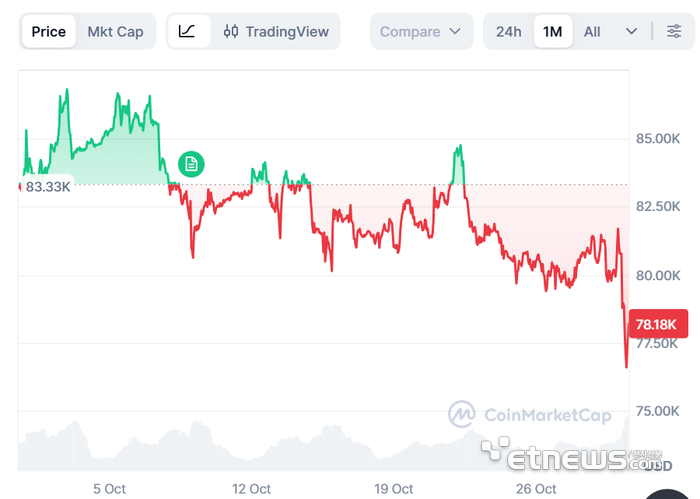
Bitcoin has continued its downward trend even in October, traditionally considered a bullish month, casting doubt on expectations of a year-end recovery to $100,000. Weakened upward momentum—due to slowing inflows into U.S. spot Bitcoin ETFs, selling pressure from long-term holders, and now hacking allegations against the world's largest crypto exchange, Binance—has further dampened investor sentiment.
On October 1, Bitcoin fell below $77,000 on CoinMarketCap, hitting a six-week low. The decline was exacerbated by rapidly shrinking investor confidence following reports of a potential Binance hack.
October is historically a strong month in crypto markets, even earning the nickname “Uptober” (a blend of “up” and “October”). Bitcoin rose in nine out of 12 Octobers from 2014 to last year. However, this year—like 2023—has seen continued declines, leaving investors' bullish expectations unmet.
Key factors behind October's weakness include uncertainty over U.S. monetary policy and slowing buying momentum. The Federal Reserve's potential for further tightening and weakened risk appetite in tech stocks have pressured Bitcoin prices. Additionally, inflows into spot ETFs—a key driver of recent gains—have significantly slowed.
From October 1 to 28, U.S. spot Bitcoin ETFs saw net inflows of approximately $110 million, a sharp drop from September's $2.6 billion.
Selling pressure from investors who bought Bitcoin at higher prices also threatens a rebound. According to blockchain analytics firm Glassnode, long-term holders purchased around 4 million Bitcoin between $85,000 and $118,000—well above current levels. If prices rise, these holders could sell to cut losses, limiting upward momentum.
The $84,000-$85,000 range has repeatedly acted as a resistance level this year. Glassnode noted that sustained ETF inflows and trading volume growth would be needed to confirm a breakout above this threshold.
Amid weakening market momentum, Binance's hacking allegations added to the negative sentiment. On October 30, Binance announced that an internal investigation found an employee's laptop was compromised, potentially allowing unauthorized withdrawals. The estimated impact was around $6.3 billion.
Binance stated it froze approximately $3 billion in related assets and will cover all customer losses using its SAFU (Secure Asset Fund for Users) fund and corporate reserves.
Attention now turns to whether financial institutions' year-end $100,000 price forecasts will hold. Bernstein set a $125,000 target in August, while TD Cowen raised its forecast from $97,500 to $109,000 on October 8.
Key variables moving forward include Binance's handling of the incident, the November 3 U.S. midterm elections, U.S. monetary policy, and ETF fund flows.
Kim Min-seung, head of DigitalX Research Center, said, “Hacks are technically complex for ordinary investors to understand, so even news of an incident—regardless of its cause or scale—can trigger panic. In the short term, the U.S. midterms and the Iran conflict are critical price drivers.”
