





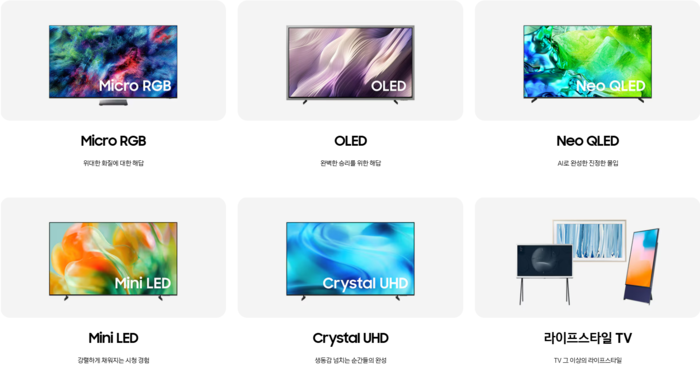
Samsung Electronics will completely reorganize its premium TV lineup next year into a three-tier structure consisting of Ultra, Plus and Basic. The company will move away from emphasizing complex hardware technology names such as Micro RGB, OLED, Neo QLED and Mini LED, instead introducing a classification system that intuitively conveys each product's tier and value.
The strategy is seen as an effort to boost consumer purchases through clearer product classifications as Samsung plans to discontinue mass production of premium quantum dot (QD) TVs after next year and simplify its hardware architecture around backlight units (BLUs). Some analysts also view the move as preparation for an eventual restructuring of its revenue model around artificial intelligence (AI) subscription services rather than hardware sales.
According to industry sources on Nov. 1, Samsung Electronics is pursuing plans to simplify its higher-end TV lineup scheduled for release next year into three tiers — AI TV Basic, Plus and Ultra — excluding its entry-level conventional liquid crystal display (LCD) TV series, Crystal UHD. The structure resembles the company's Galaxy S smartphone lineup, which consists of standard, Plus and Ultra models.
The main reason Samsung Electronics is reorganizing its long-standing technology-based TV lineup is that the hardware architecture of premium TVs has become increasingly simplified around backlight technology. Samsung plans to end mass production of QD TVs, which have been a key pillar of its premium TV lineup for nearly a decade, after next year.
As a result, virtually all higher-end products supplied from next year will shift toward technologies based on backlighting, including Mini LED and Micro LED. (See related article on Page 1 of The Electronic Times' Sept. 18 edition.)
Detailed differentiation at the component level will still be possible, such as placing smaller LED elements in backlights or applying red, green and blue (RGB) micro LED chips. Broadly speaking, however, these technologies fall within similar categories of hardware that use backlighting.
With the boundaries between technologies becoming increasingly blurred, Samsung is believed to have concluded that listing complex technology names no longer provides consumers with meaningful points of differentiation. The company has therefore opted for a more intuitive high-, mid- and low-tier structure instead of hardware-based product names.
“Although the tiers will not be strictly divided by technology, Ultra is expected to focus on Micro RGB TVs and organic light-emitting diode (OLED) TVs incorporating high-value-added technologies, while Basic will consist largely of lower-value-added Mini LED TVs,” an industry official said.
The standardization and simplification of hardware technologies are also closely linked to Samsung Electronics' shift in its TV business revenue model. Industry observers believe the lineup overhaul is part of a broader strategy to restructure revenue streams away from hardware sales and toward AI-based subscription services.
The idea is to simplify the premium TV lineup and sell more units at lower margins while bundling AI subscription services to lock customers into the Samsung TV ecosystem.
“Samsung Electronics plans to increase its TV shipments from around 35 million units this year to well over 40 million units next year,” another industry official said. “The lineup simplification is intended to secure new revenue sources based on the AI ecosystem rather than relying primarily on hardware.”
