


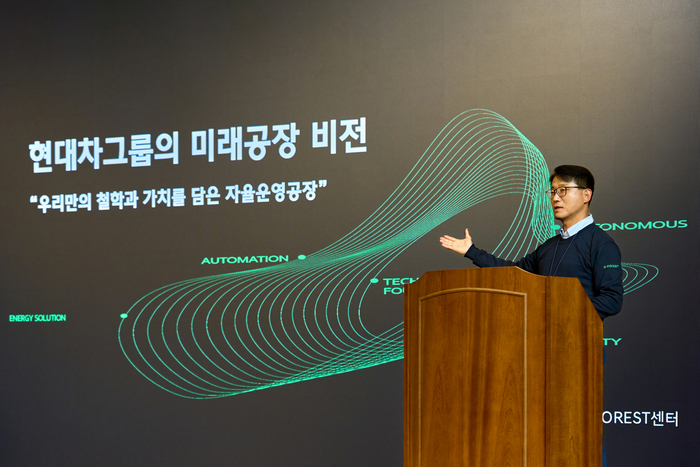
Hyundai Motor and Kia have officially confirmed that mass production at their new Ulsan EV plant—the group's first dedicated electric vehicle manufacturing facility in South Korea—will commence this month. The automakers also unveiled a blueprint for “autonomous factories,” where data and artificial intelligence drive operations and continuous self-evolution, alongside a mid-to-long-term roadmap to integrate humanoid robots into next-generation production sites by 2032.
At a media briefing held during the E-FOREST Tech Day 2026 exhibition at the group's Uiwang Research Center in Gyeonggi Province, Hyundai and Kia outlined their transition strategy toward Software-Defined Factories (SDF).
“Building on the smart technologies deployed at the Hyundai Motor Group Innovation Center Singapore (HMGICS) and the Hyundai Motor Group Metaplant America (HMGMA), we have established an optimized manufacturing ecosystem at our new Ulsan EV plant, which begins commercial operations this month,” said Choi Young-tae, Vice President and Head of the E-FOREST Center at Hyundai and Kia's Manufacturing Solution Division, formally announcing the plant's October launch.
The group also revealed video footage of the actual body-in-white, paint, and final assembly lines at the Ulsan facility, which recently completed pilot runs and is ready for full-scale commercial manufacturing.
Looking beyond mechanical automation, Hyundai and Kia presented a roadmap for autonomous plants capable of learning and evolving independently via data and software. Under this initiative, end-to-end data will connect the entire automotive value chain—from vehicle development to production and real-world quality feedback. To resolve fragmentation across different plant sites, the group is establishing a standardized manufacturing platform structured around a tech foundation, core systems, and manufacturing applications.
The automakers also detailed their robotics roadmap, which calls for deploying robots powered by “Physical AI”—equipped with advanced machine vision and spatial cognitive capabilities—to handle complex, non-standard component assembly. “We plan to advance our virtual-based autonomous manufacturing systems at HMGICS by 2030 and progressively deploy humanoid robots alongside full-scale autonomous technologies in future smart factories starting in 2032,” Choi noted.
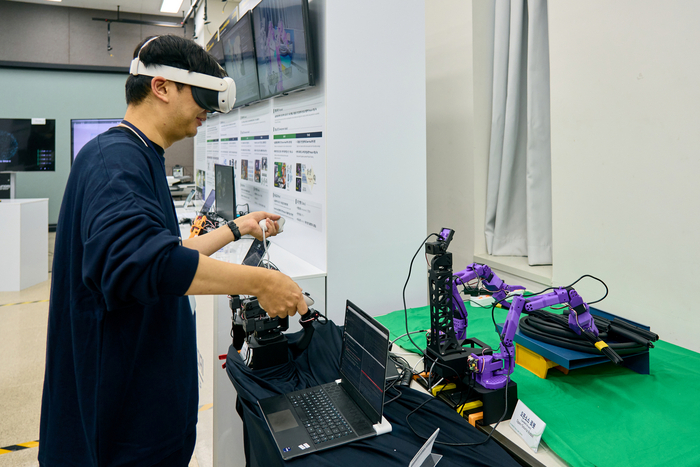
The exhibition floor at the Uiwang Center offered a preview of the future smart factory, blurring the lines between physical reality and digital simulation. In the manufacturing software zone, a researcher wearing a VR headset manipulated handheld controllers, prompting a robotic arm in virtual space to route and fasten wiring harnesses with precision.
At an adjacent booth, “Polaris”—an industrial AI platform piloted at the new Ulsan EV plant—responded within one second to the voice command, “Show me current production status.” The system instantly displayed real-time operating rates, diagnosed bodywork defects, and recommended troubleshooting protocols. Polaris, which is split into a plant-specific “Factory” edition and a “General” enterprise version, entered pilot operations at the Ulsan facility in September.
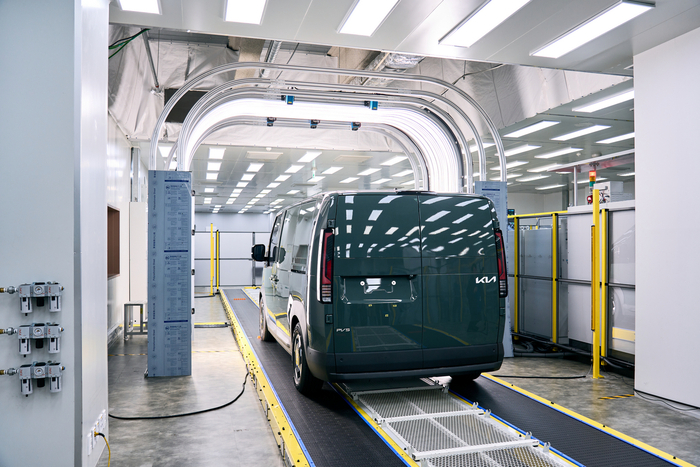
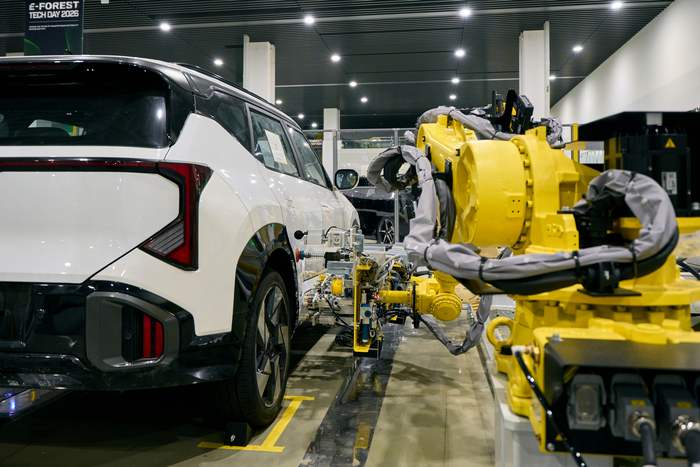
Automation of traditionally delicate assembly tasks, which previously relied on the tactile expertise of veteran technicians, also drew attention. Industrial robots seamlessly installed flexible rubber weatherstrips and door garnishes without deviation. In-plant logistics and quality inspection showcased similar levels of intelligent automation. Standard automated guided vehicles (AGVs) with rapid 12-minute recharge cycles navigated shop floor transit routes, while an arched inspection tunnel deployed proprietary machine-vision systems—utilizing dozens of synchronized cameras—to detect microscopic surface imperfections on entering vehicles, including Kia's purpose-built vehicle (PBV) PV5.
“The technologies showcased today are not about simply replacing human labor, but rather liberating workers from hazardous, repetitive tasks so they can focus on high-value cognitive and strategic roles,” a Hyundai-Kia spokesperson said. “We will continue to drive smart factory innovation centered on software and artificial intelligence.”
Running from October 19 to 21, the 7th E-FOREST Tech Day features roughly 200 proprietary technologies developed by Hyundai, Kia, and tier-one partners, spanning SDF architecture, robotics, and intelligent automation, alongside supplier technical seminars and new manufacturing technology presentations.
