





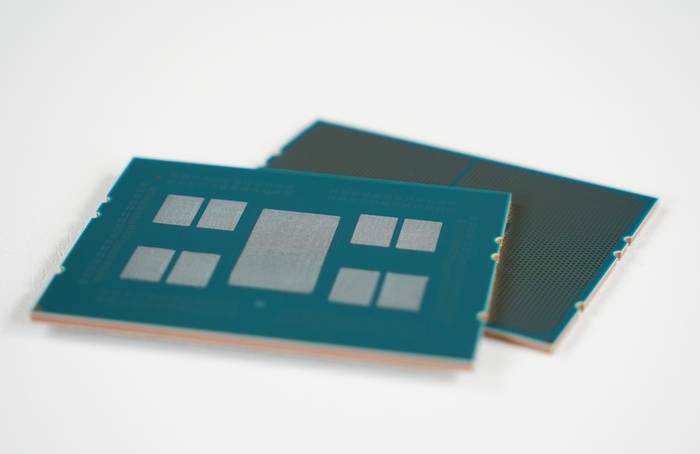
The proliferation of artificial intelligence (AI) has driven a surge in demand for both semiconductors and substrates, leaving the industry struggling to secure manufacturing equipment.
It has been found that securing certain types of substrate manufacturing equipment takes more than two years. With delivery times for semiconductor manufacturing equipment recently extending to three years or longer in some cases, equipment shortages are now spreading to the substrate manufacturing industry. (See Page 1 of the Nov. 4 edition of The Electronic Times.)
According to industry sources on Nov. 25, delivery lead times for certain processing equipment used to produce flip-chip ball grid array (FC-BGA) substrates have increased to nearly five times their usual levels. Equipment that previously could be delivered within approximately six months of placing a purchase order (PO) now requires a wait of about 30 months.
“Some major substrate manufacturers are even making advance payments to equipment suppliers to request expedited delivery,” an equipment industry official familiar with the matter said. “However, it takes a long time to actually receive FC-BGA manufacturing equipment, and only a limited number of substrate manufacturers have secured supply commitments.”
This means that because the supply of FC-BGA substrate manufacturing equipment is limited, only substrate manufacturers with sufficient purchasing power can secure equipment ahead of their competitors.
The situation stems from expanding investment in AI infrastructure. As demand for AI semiconductor chips has surged, large quantities of FC-BGA substrates, an essential component, have also become necessary. Global FC-BGA substrate manufacturers have consequently rushed to expand production capacity. The simultaneous surge in purchases of equipment needed for substrate production has created supply bottlenecks.
Major FC-BGA substrate manufacturers include Japan's Ibiden and Shinko Electric Industries and Taiwan's Unimicron. In South Korea, Samsung Electro-Mechanics is a leading player, while Daeduck Electronics and LG Innotek are also aggressively targeting the market.

Manufacturers of key FC-BGA substrate equipment, including bonding, cutting and metallization equipment, are also facing difficulties. Although rising orders are expected to allow them to benefit from AI investment, they lack sufficient capacity to deliver equipment on time.
The biggest obstacle is securing components. More advanced equipment tends to rely more heavily on Japanese-made components, but Japanese component manufacturers have limited production capacity. In particular, difficulties have reportedly emerged in securing components such as precision motors for stages, various drive components, servo motors, drivers and controllers.
“Japanese-made components that would normally be available for immediate purchase now require a wait of about six months,” the head of an FC-BGA bonding equipment manufacturer said. “Unless we secure inventories in advance, production of FC-BGA equipment could be disrupted.”
FC-BGA substrate manufacturers are on high alert. Large-scale capacity expansions are immediately necessary to meet AI-driven demand, but manufacturers could fall behind in the production race if they fail to bring in the necessary equipment. As a result, efforts to secure essential equipment ahead of competitors are mounting. Some substrate manufacturers are even sending letters of intent to equipment suppliers before placing formal orders in an effort to secure supplies in advance.
“Companies operating in both semiconductor and substrate manufacturing equipment businesses are experiencing particularly heavy inflows of purchase orders, resulting in longer delivery lead times,” another equipment industry official said. “Competition to secure equipment ahead of rivals is expected to remain intense until investment in FC-BGA substrate production facilities is largely completed.”

◇ Glossary: Flip-Chip Ball Grid Array (FC-BGA)
Unlike conventional wire bonding, which connects a chip to a substrate using metal wires, FC-BGA is a method in which the chip is flipped over and directly connected to the substrate through metal bumps. It offers superior heat dissipation and signal transmission performance.
