




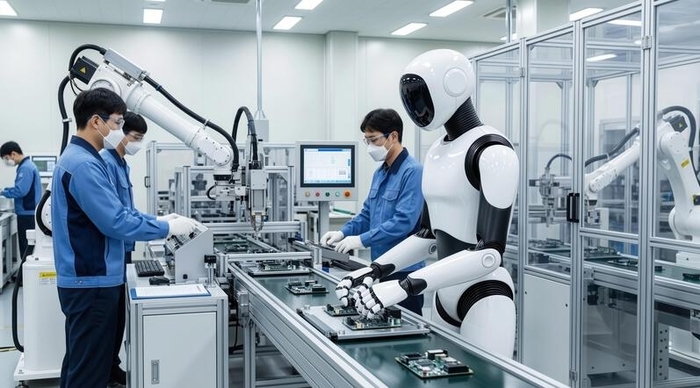
As the government expands the pilot distribution of humanoids, work has begun domestically to establish separate safety guidelines.
According to industry sources on the 18th, the Korea Robot Industry Promotion Agency and others have started preparing guidelines and verification standards to evaluate the safety and performance of humanoids. They are currently reviewing drafts with relevant ministries and plan to refine detailed criteria by incorporating feedback from industrial sites, including actual robot testing.
The humanoid guidelines are a response to the government's plan to directly purchase and distribute approximately 1,700 robots next year, expanding to a cumulative total of 15,000 by 2030. Among these, the government plans to purchase 250 domestically produced humanoids next year for distribution to universities and national research institutes, with cumulative purchases reaching 1,080 by 2030.
The challenge lies in the fact that most domestic humanoid companies lack mass production experience, and there are no applicable international safety standards. While the government and Daegu City began the “Humanoid Robot Safety Certification Center Construction Project” this year, the center's completion is targeted for 2030—later than the pilot distribution project starting next year.
Humanoids are more difficult to establish safety standards for than traditional industrial robots. Unlike fixed robotic arms, humanoids move their entire bodies, requiring considerations for weight, walking speed, joint output, impact during falls, human contact, object drops, and AI misjudgments.
The current Industrial Safety and Health Act requires protective measures such as safety fences for industrial robots. Applying these directly to humanoids contradicts the purpose of their introduction, which involves collaborating in shared spaces with humans, according to industry feedback. Some companies are using regulatory sandboxes or implementing separate protective measures for testing, but this imposes burdens such as redesigning workspaces.
The International Organization for Standardization (ISO) is also in the process of expanding evaluation items for humanoids based on existing industrial and service robot safety standards like “ISO 10218.” The industry estimates that dedicated safety standards will not be finalized until around 2029 at the earliest.
In rapidly growing markets like China, the government and companies are collaborating to accumulate real-world data while simultaneously developing guidelines and national standards. Major companies in fields such as UBTECH, Unitree, and Ajinbot, along with research and testing institutions, are developing safety standards for general, industrial, household, and public service applications.
A robot industry official stated, “Applying current industrial robot standards directly to humanoids would require additional measures like safety fences every time they move, making practical field use difficult.” They emphasized, “There is an urgent need to establish guidelines, standards, and certification systems that reflect the collaborative nature of humanoids with humans while ensuring safety.”
