








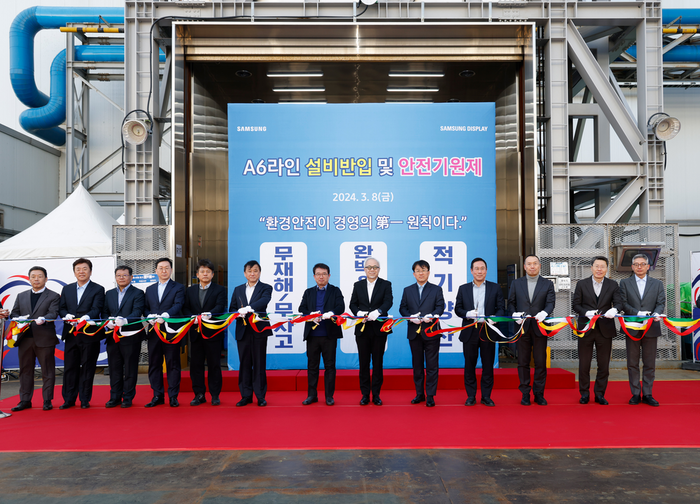
Samsung Display is introducing equipment related to Low-Temperature Polycrystalline Oxide (LTPO) Thin-Film Transistors (TFT) to its second 8.6-generation Organic Light-Emitting Diode (OLED) production line.
LTPO is a mainstream OLED technology mainly applied to smartphones, and it is predicted that Samsung Display may utilize its 8.6-generation facilities for smartphones in addition to laptops in the long term.
According to the industry on the 7th, Samsung Display recently ordered Excimer Laser Annealing (ELA) equipment, which is a core process for LTPO. Specifically, instead of purchasing new equipment, they plan to retrofit two units of 6th-generation OLED ELA equipment they already possess into 8.6-generation equipment.
An industry official familiar with the matter predicted, “This equipment is expected to be delivered around the first half of next year,” and “It is highly likely to be brought in to match the delivery schedule of the ion implanters ordered from Japan's Nissin last year.”
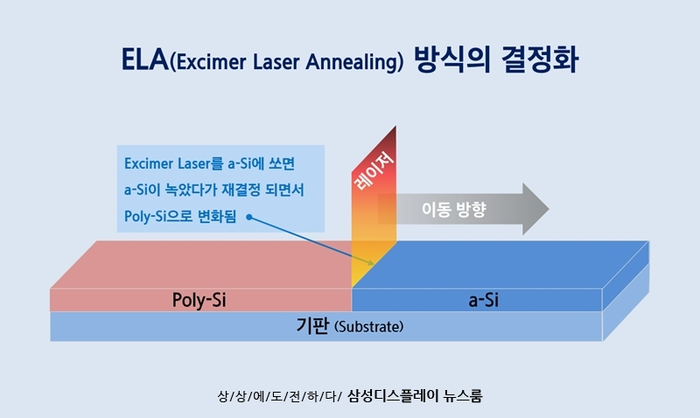
ELA is an essential process for implementing LTPO TFT. LTPO is based on Low-Temperature Polycrystalline Silicon (LTPS) TFT, characterized by fast electron mobility, combined with Oxide technology, characterized by low leakage current. LTPS is implemented with ELA lasers, and Oxide technology is added to create LTPO.
Oxide is advantageous for lowering manufacturing costs because it does not require processes and equipment such as ELA and ion implantation, but LTPO has superior performance as Oxide has lower electron mobility compared to LTPO. For this reason, LTPO is suitable for applications requiring higher performance, and the representative product is the smartphone.
Samsung Display's attempt to build LTPO equipment in addition to Oxide TFT is analyzed as a strategic move to respond to various customer orders.
Initially, Samsung Display designed all 8.6-generation OLED production lines using the Oxide TFT method. They established facilities with a capacity of 15,000 glass substrates per month; the first line of 7,500 substrates per month, which enters mass production in June or July this year, is the Oxide method. Samsung Display will use this facility to manufacture OLEDs for Apple's MacBook Pro, scheduled for release in the second half of this year.
Unlike laptops that use Oxide TFT, Apple applies LTPO and LTPS TFT technology to tablets. This means that if the subsequent lines are made with LTPO, the application for 8.6-generation OLEDs can be expanded to tablets.
In the mid-to-long term, 8.6-generation OLEDs for smartphones can be produced. Although the IT OLED market, including tablets and laptops, has begun to bloom, the penetration rate of OLED in the laptop market is still very low. There is a high possibility of targeting the smartphone market, where the OLED adoption rate is high.
According to market research firm TrendForce, the OLED penetration rate in the laptop market recorded 5% last year. It is projected to be around 7.4% this year, when OLED is applied to the MacBook Pro, and will only exceed 20% by 2029.
A display expert said, “To prepare for cases where the IT OLED market expands slower than expected, the construction of LTPO lines, which are advantageous for securing customers, will be inevitable.”
