








South Korean and Chinese display makers are ramping up competition in next-generation OLED technology by unveiling phosphorescent-sensitized fluorescence (PSF) OLED solutions, widely viewed as a promising advancement for future displays.
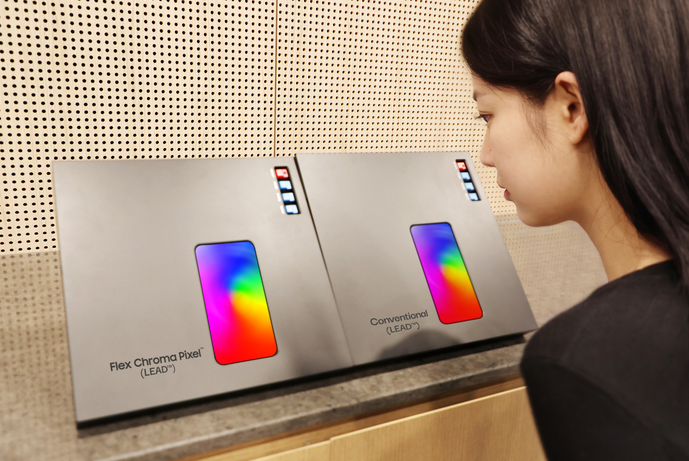
At SID Display Week held in the United States this month, Samsung Display introduced its “Flex Chroma Pixel” smartphone OLED technology incorporating a green PSF emitter.
The technology supports a wide color gamut covering 96% of the BT.2020 standard even at a peak brightness of 3,000 nits. Achieving both high brightness and a broad color range simultaneously has traditionally been difficult, but Samsung Display said the PSF-based device overcomes that limitation.
PSF technology works by allowing fluorescent materials, known for their relatively long lifespan, to handle more electrical charge while phosphorescent materials emit the actual light. This approach narrows the light wavelength spectrum, improving energy efficiency and enabling richer, more vivid colors.
Chinese display manufacturers have also begun adopting green PSF technology in domestic smartphone models this year, setting the stage for fierce technological rivalry. Their shared goal is to meet the BT.2020 color gamut standard.
BOE commercialized the technology earlier this year by supplying a limited quantity of green PSF OLED panels for newly launched Huawei smartphones. The company is also expected to provide panels for upcoming follow-up models scheduled for release in the second half of the year.
Visionox is likewise developing green PSF technology in partnership with U.S.-based Universal Display Corporation (UDC). The company has reportedly been supplying PSF OLED panels to smartphone makers since late last year, although its customers have not been disclosed.
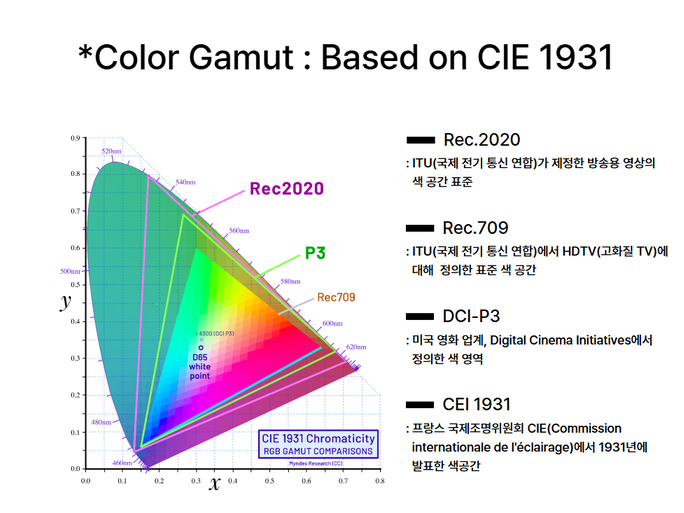
BT.2020, also known as Rec.2020, is a color gamut standard established in 2012 for ultra-high-definition television broadcasting. It is now widely used in UHD, 4K, and 8K broadcasting and content production.
Major smartphone manufacturers such as Apple and Samsung Electronics currently use displays that satisfy more than 99% of the DCI-P3 color standard. According to Samsung Display, this corresponds to roughly 70% of the BT.2020 standard.
Industry analysts believe display panel makers are initially focusing on green PSF because material research is more advanced and the substitution effect is greater, making it a practical first step toward evolving smartphone OLED technology.
In the longer term, PSF is attracting attention for its potential application in blue phosphorescent OLEDs, which still rely largely on fluorescent materials today. Phosphorescent materials theoretically achieve nearly 100% energy conversion efficiency, about four times higher than fluorescent materials, which operate at around 25% efficiency.
However, blue phosphorescent materials have faced major challenges due to their short wavelengths and high energy levels, resulting in shorter lifespans and reduced display stability.
A display industry expert said, “PSF is not only effective in improving color purity, but is also increasingly being explored as a way to enhance power efficiency in smartphones. As additional material layers such as fluorescence, phosphorescence, and hosts are introduced, achieving uniform deposition becomes more difficult. Verifying mass-production efficiency will be the key factor for commercialization going forward.”
