








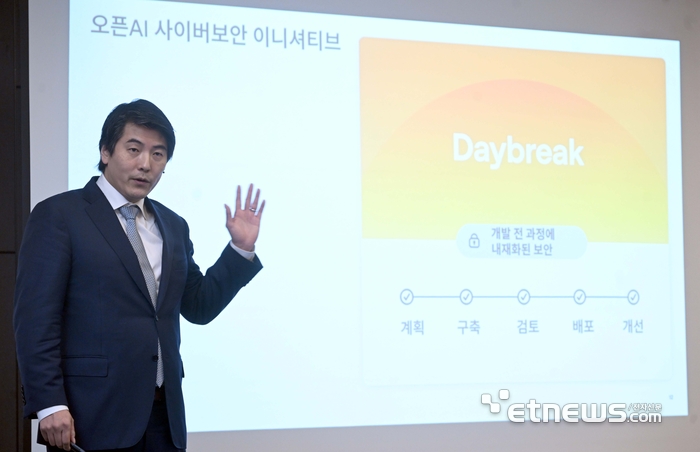
OpenAI is launching 'Daybreak', a state-of-the-art artificial intelligence (AI)-based cybersecurity initiative.
Based on trust, it will fully support strengthening the state-of-the-art AI-based cyber defense capabilities of not only the U.S. government but also the governments, public sectors, and enterprises of U.S. allies such as Canada, South Korea, Japan, and the European Union (EU).
Jason Kwon, chief strategy officer (CSO) of OpenAI, said at a press conference held at the JW Marriott Hotel in Seocho-gu, Seoul, on the 27th, “If AI is to become part of the systems people rely on, cybersecurity must also be part of making those systems trustworthy and resilient,” clarifying the move.
Daybreak is a framework that utilizes state-of-the-art AI capabilities to support developers in making software (SW) and digital systems more secure from the start. It plans to gradually strengthen cybersecurity capabilities in line with OpenAI's latest high-performance AI models 'GPT-5.5' and 'GPT-5.5 Cyber', as well as OpenAI's latest models to be disclosed in the future.
OpenAI also formalized the launch of the 'Korea Cyber Action Plan', which allows the South Korean government, public agencies, and domestic enterprises to have broad access to advanced AI-based cyber defense capabilities centered on Daybreak. The main point is not only providing briefings and demonstrations on the latest cyber AI capabilities, but also expanding accessibility to advanced cyber models for the South Korean government, public sectors, and enterprises.
The company plans to contribute to strengthening AI-based security in the Korean market by supporting the 'Government and Agency Trust-based Access Program (GTAC)' in the cyber field, in which the Korea Internet & Security Agency (KISA) participates, as well as the Trust-based Access Program (TAC) for major enterprises in domestic industry groups.
This move contrasts with Anthropic, which restricts governments and enterprises of other countries, except the U.K., from joining 'Project Glasswing'--a verification community for its latest security-enhanced AI model 'Claude Mythos Preview'--citing policies of the U.S. government and other reasons.
Kwon, chief strategy officer, emphasized, “OpenAI, in essence, intends to share the advanced capabilities of AI-based security with the defenders of democracy,” adding, “We plan to support strengthening AI-based security before attacks by malicious actors (such as hackers) occur by expanding access for trusted entities.”
OpenAI is currently discussing GTAC cooperation with EU countries and is also conducting discussions with Korean enterprises that have requested participation in TAC.
In addition, it will expand cooperation with public agencies, not only in the cybersecurity area with KISA, but also in climate change and water management with the Korea Water Resources Corporation (K-water), and AI-based technology evaluation with the Technology Guarantee Fund (KOTEC). Based on cases of cooperation with the U.S. AI Safety Institute and the U.K. AI Safety Institute, OpenAI also announced plans to support capability reinforcement, such as AI safety, of the Korea AI Safety Institute.

OpenAI is also pushing to establish a domestic data center as part of the 'Stargate' project. Kwon said, “We are having productive conversations with SK and Samsung to establish computing deployment plans.”
Meanwhile, regarding the latest AI coding agent 'Codex' on this day, statistics were also announced showing that the number of weekly active users has increased 10 times since its launch last February, daily usage has increased 30 times, and South Korea is among the top 5 countries in the world regarding Codex participation.
Kwon explained, “In South Korea, 50% of code assist requests are for non-coding tasks, meaning it is used not only by professional developers but also by people who want to turn ideas into useful tools,” adding, “The number of global ChatGPT weekly active users is over 900 million, and more than 1 million enterprises are using OpenAI technology within their organizations.”
