








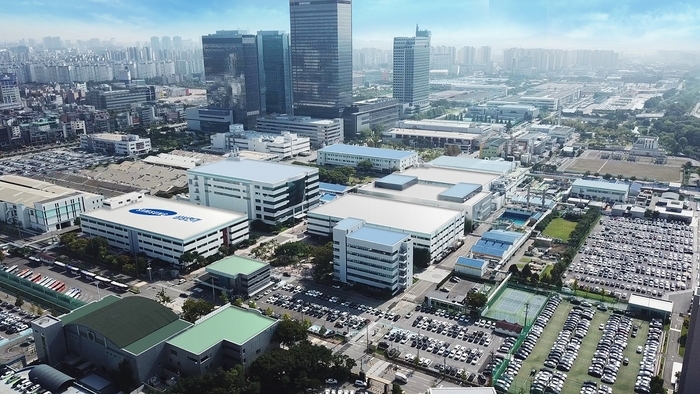
Samsung Electro-Mechanics is accelerating its strategic shift toward high-value components for Artificial Intelligence (AI) servers and Electric Vehicles (EV). By aggressively expanding its Research and Development (R&D) investments, the company aims to move beyond its traditional reliance on smartphone components and establish automotive, server, and high-performance package substrates as its primary growth engines.
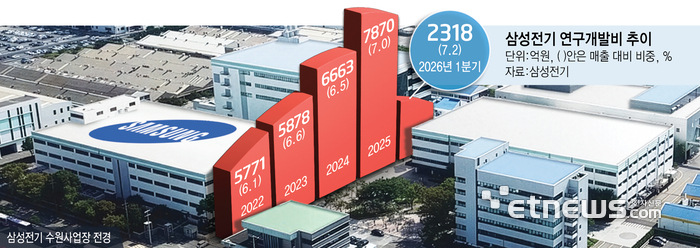
According to industry sources on May 28, the company's R&D expenditure has seen a significant upward trajectory, rising from 577.1 billion KRW in 2022 to an estimated 787 billion KRW in 2025--a 36% increase in just three years. The R&D-to-sales ratio also climbed from 6.1% to 7.0% during the same period. This trend continued into the first quarter of 2026, with R&D spending reached 231.8 billion KRW, or 7.2% of quarterly revenue.
This increased spending is being funneled directly into the development of high-reliability components for the evolving EV and AI sectors. In the EV segment, the company has developed ultra-high-voltage Multilayer Ceramic Capacitors (MLCC) in the 1,000V to 1,250V range for charging systems. It has also secured a lineup of 35V medium-voltage MLCCs to meet the demand for high-output fast charging. These innovations are designed to keep pace with EV power systems as they transition toward higher voltage and efficiency standards.
In the autonomous driving market, Samsung Electro-Mechanics is strengthening its camera module technology. The company has established a full lineup of 8-megapixel high-resolution cameras to support the expanding Advanced Driver Assistance Systems (ADAS) market. These modules are critical components that must balance high-performance recognition with extreme durability and reliability.
For the AI server market, the company is positioning Flip-Chip Ball Grid Array (FCBGA) substrates as a major pillar of growth. By developing next-generation FCBGA substrates for high-spec server CPUs, Samsung Electro-Mechanics is restructuring its substrate business to focus exclusively on premium, high-margin products.
Investment in AI server package substrates is expected to grow even further in the coming years.
During the Q1 2026 earnings call, Kim Pan-bae, Vice President of the Package Solution Business Unit, noted that demand from Big Tech data centers is skyrocketing. “The increasing sophistication of substrate specifications is absorbing our production capacity so rapidly that it is becoming difficult to meet all customer requests with our current facilities,” Kim stated.
He further added, “We are evaluating additional investments to expand the supply of next-generation products from 2027 onward. We plan to aggressively scale our FCBGA business to meet the surging demand for high-value package substrates in the AI data center sector.”
