








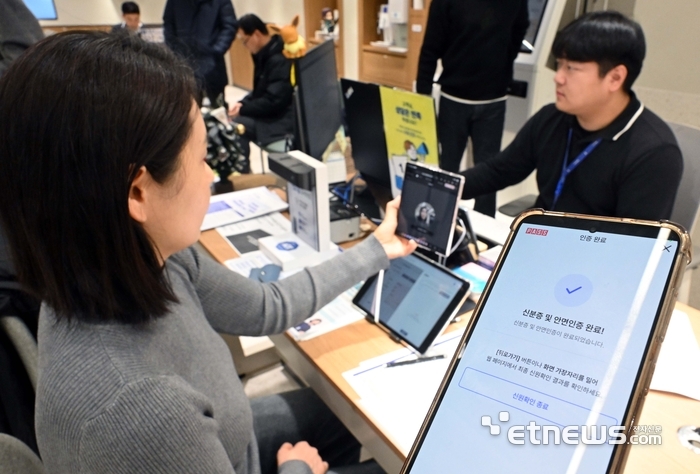
South Korea's Ministry of Science and ICT has begun establishing the legal framework for the formal implementation of a facial recognition verification system for mobile phone subscriptions. The goal is to support the legitimacy and long-term sustainability of the program by explicitly allowing the use of biometric information for identity verification within enforcement regulations. However, concerns remain among mobile phone retailers and distributors over low recognition rates and the lack of fully developed alternative verification methods.
According to industry sources on June 23, the Ministry of Science and ICT announced a proposed amendment to the Enforcement Decree of the Telecommunications Business Act.
The key change is the use of biometric information to prevent fraudulent mobile phone registrations. A newly added provision (Article 37-7, Paragraph 3) states that, when necessary for identity verification and fraud prevention during mobile phone activation, biometric data such as facial images and fingerprints may be compared--with the individual's consent--against information held by government or public institutions, or against photographs on official identification documents.
The measure partially reflects recommendations from the National Human Rights Commission of Korea and the Personal Information Protection Commission (PIPC), both of which had raised concerns about insufficient legal grounds and potential infringements on sensitive personal information. The PIPC had previously recommended improvements to the system, arguing that the legal basis for using facial information as an identity verification method was inadequate. If the amendment passes through vice-ministerial and Cabinet review without significant objections, it is expected to take effect after October, in line with the implementation of the revised law.
Despite progress on the regulatory front, market readiness remains slow. The Ministry plans to conclude its pilot program for facial recognition-based mobile phone activation by the end of this month.
Industry stakeholders believe confusion is inevitable due to the gap between the planned rollout of the system and the completion of the legal framework. With only about a week remaining before the scheduled launch, alternative verification methods and procedures for cases where facial recognition fails have yet to be finalized.
Three alternatives are currently under consideration: the Ministry of the Interior and Safety's mobile ID, a certified copy of the resident registration record, and the identity verification service available through the PASS app. Individuals who do not wish to use facial recognition may instead use a mobile ID.
However, the resident registration document option has limitations. Users must visit a local administrative office to obtain the document, and verification may be difficult when activating a phone because of a lost or damaged existing device. To address this issue, the government is considering allowing electronically issued copies as an exceptional alternative. Another challenge is that telecommunications providers currently lack systems capable of verifying both the submission and authenticity of such documents.
The mobile phone distribution industry is calling for a grace period until October, when the revised enforcement decree is expected to take effect. During that time, stakeholders say the government should establish a comprehensive alternative verification framework and improve facial recognition accuracy through technical enhancements.
A telecommunications industry official said, “If the system is introduced in July without adequate preparation, significant confusion is likely at the front lines. Because sensitive personal information is involved, both procedural fairness and technical security must be fully guaranteed.”
A Ministry of Science and ICT official said, “We are reviewing various options regarding the timing of the formal implementation of the facial recognition system. We will continue to gather feedback from stakeholders and make institutional and technical improvements even after the system is introduced.”
