








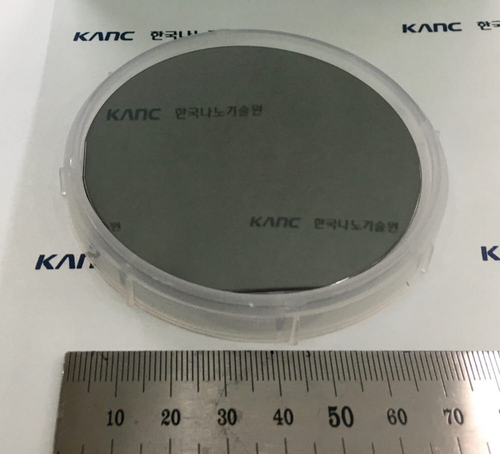
As demand for optical communications surges with the rapid expansion of AI data centers, shortages of indium phosphide (InP) substrates are becoming more severe. Leading companies are accelerating the transition from 2-inch to 6-inch wafers and expanding production capacity, but demand is rising even faster, driving up prices and widening supply gaps. Despite growing domestic demand, South Korea has yet to establish an InP substrate production supply chain, underscoring the urgent need to secure related technologies.
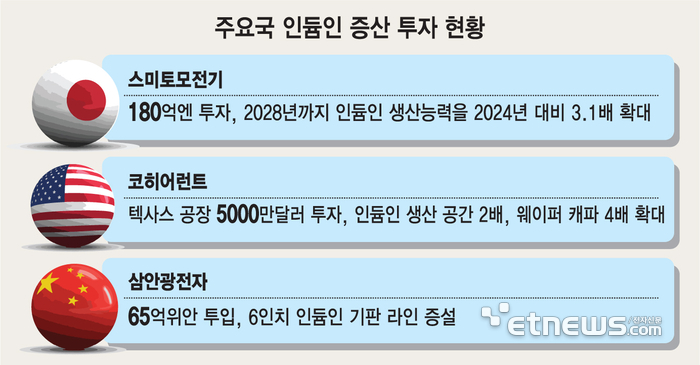
According to industry sources on July 7, Sumitomo Electric, the world's largest InP substrate supplier, recently announced plans to invest JPY 18 billion to increase its InP production capacity to 3.1 times its 2024 level by 2028. The company had previously announced in November that it would expand capacity by 2.4 times but has since raised its target in response to stronger-than-expected demand.
Major companies in the United States and China are also ramping up production with government support. Last month, U.S.-based Coherent unveiled a $50 million investment to double its InP manufacturing space and quadruple wafer production capacity at its Texas facility. Meanwhile, China's San'an Optoelectronics has been investing CNY 6.5 billion since last year to build a new 6-inch InP substrate production line.
Indium phosphide (InP) is an irreplaceable material in the optical communications ecosystem. Optical semiconductors require laser source devices that supply light, and InP--a direct bandgap semiconductor--is the only commercially viable material capable of performing this role.
While conventional data centers rely on copper interconnects, hyperscale AI data centers now under construction are rapidly adopting 800 Gbps and 1.6 Tbps high-speed optical modules to meet growing performance demands. This expansion is driving a sharp increase in demand for InP substrates.
According to Chinese brokerage Dongwu Securities, global effective production capacity for InP substrates this year is estimated at only 600,000 to 750,000 wafers annually. In contrast, market demand is projected to reach 2.6 million to 3 million wafers, leaving a substantial supply gap. Major technology companies, including NVIDIA, have already begun securing InP supply chains to ensure a stable supply of laser source materials.
The supply shortage has sent prices soaring. The price of a 2-inch InP substrate for optical communications was around $800 per wafer in 2025, but climbed to $2,300-2,500 by April 2026--more than tripling in roughly a year.
Despite strong domestic demand, South Korea remains largely absent from the InP substrate manufacturing supply chain. Government industrial policy has primarily focused on conventional silicon (Si) semiconductors and power semiconductors such as silicon carbide (SiC) and gallium nitride (GaN). Industry experts estimate that Korea trails Japan by more than a decade in InP substrate production technology, particularly in mass-producing high-quality 4-inch and 6-inch wafers and obtaining customer certifications.
Although several research institutes and universities are conducting small-scale studies on InP single-crystal growth, the country has yet to establish a commercial-scale manufacturing base. Experts say Korea urgently needs to develop a complete downstream value chain, including refining indium into ultra-high-purity semiconductor-grade material and processing it into single-crystal substrates.
“Although demand for InP is growing rapidly, Korea Zinc is currently the country's only producer of high-purity indium feedstock,” an industry official said. “Without a domestic InP substrate supply chain, Korea could face significant supply chain risks, potentially delaying AI data center construction and creating bottlenecks in optical communications infrastructure.”
