








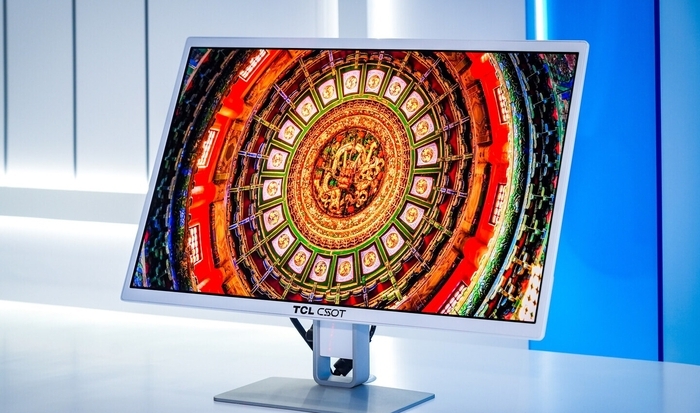
China's TCL is moving up its production schedule for medium- and large-sized OLED panels, a development expected to reshape the premium IT display market for monitors, laptops, and tablets.
TCL's display subsidiary, TCL CSOT, has completed internal validation of its 27-inch 4K 120Hz RGB-stripe OLED monitor panel, manufactured using inkjet printing technology, and is preparing to begin mass production.
Excluding specialized applications such as medical displays, this effectively marks TCL's first in-house production of medium- and large-sized OLED panels.
The panel is reported to offer 300 nits of brightness and 99% DCI-P3 color gamut coverage, and will be produced at TCL CSOT's Generation 5.5 inkjet-printed OLED production line in Wuhan, China.
Last year, TCL CSOT announced a 1.5 billion yuan (approximately US$210 million) investment to triple production capacity at its Wuhan facility. The plant is expected to serve as a bridge until the company's Generation 8.6 T8 inkjet OLED fab in Guangzhou begins mass production in 2027, allowing TCL to enter the OLED panel market much earlier than originally planned.
Until now, TCL had no in-house OLED production for medium- and large-sized displays outside of smartphone panels. Even the OLED panels used in the company's latest gaming monitors launched this year were supplied by LG Display, leaving TCL almost entirely dependent on Korean manufacturers.
That competitive landscape is expected to change as TCL begins producing its own OLED panels.
TCL strengthened its position in 2023 by acquiring JOLED's inkjet-printed OLED patents and technologies following the Japanese company's bankruptcy. Unlike conventional vacuum deposition, inkjet printing deposits organic emissive materials through nozzles, much like an inkjet printer. The process can reduce manufacturing costs by more than 20% while shortening production time by roughly 30%.
Conventional vacuum deposition becomes increasingly difficult as panel sizes grow because fine metal masks (FMMs) tend to deform. Inkjet printing avoids this limitation, making it significantly more cost-effective for producing very large displays, including TVs larger than 60 inches.
However, technical challenges such as burn-in remain before the technology can be widely adopted for televisions. As a result, TCL CSOT is expected to focus first on OLED panels for monitors, laptops, and tablets. Industry observers also note that even after panel production begins, additional time will be required before finished consumer products reach the market.
Despite these challenges, TCL's entry is expected to intensify competition between Chinese and Korean display makers in the medium- and large-sized OLED market.
“Samsung Electronics and LG Electronics have been expanding their premium OLED strategy beyond TVs into the monitor market as they seek to protect profitability in the sluggish TV business,” an industry executive said. “Now, Chinese manufacturers armed with lower-cost production technologies are emerging as a serious competitive force. It will take time before inkjet printing is widely applied to large TV panels, but its pricing impact on the IT display market could be substantial.”

