






In a significant shift within South Korea's big tech landscape, Kakao has surpassed its long-time rival Naver in total renewable energy procurement for the first time. However, industry data reveals that Naver continues to lead in procurement quality, relying heavily on direct Power Purchase Agreements (PPAs) and self-generation that actively contribute to expanding the green energy infrastructure.
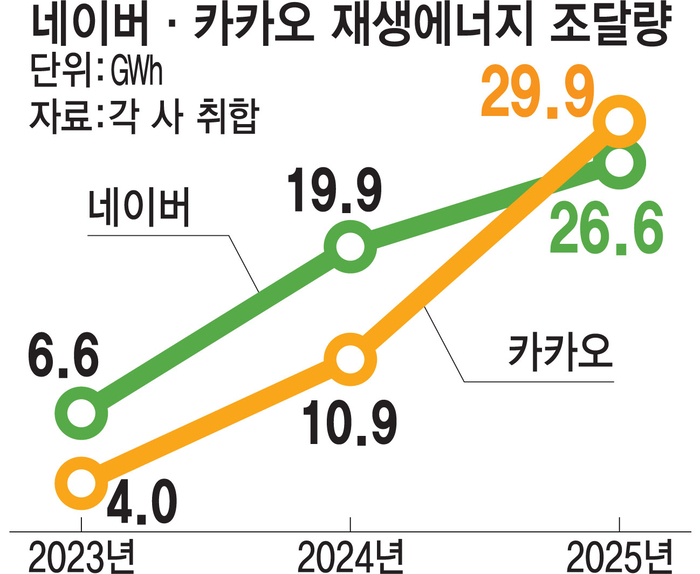
According to industry sources on June 29th, Kakao sourced 29.9 GWh of renewable energy last year--a staggering 174% surge compared to the previous year. This rapid acceleration allowed Kakao to edge past Naver, which secured 26.6 GWh, marking a 20% year-on-year increase. This is the first fiscal year where Kakao's green energy volume has eclipsed Naver's.
Kakao achieved its figures by completely transitioning its core corporate workspaces to 100% renewable energy, including its Jeju headquarters, the Pangyo Agit campus, the Yongin AI Campus, and Kakao Friends flagship stores. By focusing on these relatively low-intensity commercial office environments, the company successfully elevated renewable energy to 11.5% of its total corporate power consumption.
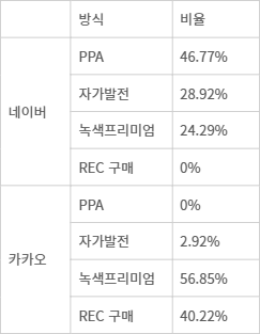
Despite the volume milestone, analysts point out a structural vulnerability in Kakao's green portfolio, which remains heavily reliant on the Green Premium system and Renewable Energy Certificates (RECs). Last year, Green Premium fees accounted for 56.8% of Kakao's clean energy mix, followed by REC purchases at 40.2%, and on-site self-generation at a mere 2.9%. Because Green Premium and RECs simply purchase existing environmental attributes rather than financing new infrastructure, their direct impact on expanding the broader renewable energy ecosystem is inherently limited.
Conversely, Naver has earned praise for a much healthier, high-impact procurement strategy. Direct corporate PPAs made up 46.7% of Naver's renewable energy portfolio, complemented by a substantial 28.9% derived from self-generated geothermal and solar assets, while the Green Premium made up the remaining 24.2%. By prioritizing long-term power contracts and direct infrastructure investment, Naver has demonstrated a higher qualitative contribution to the clean energy market.
Both tech giants are locked in a race toward identical mid-to-long-term climate targets: achieving RE60 (sourcing 60% of power from renewables) by 2030, and reaching both RE100 and full Net-Zero greenhouse gas emissions by 2040. Consequently, both firms are aggressively scaling up their procurement frameworks this year.
To address its structural limitations, Kakao executed its first-ever corporate PPA this year, commencing solar power delivery to its flagship Ansan Data Center. With a goal to source 15% of its total electricity from renewables this year, Kakao is heavily focused on diversifying its supply channels. This strategy is critical as the company faces surging energy demands driven by the expansion of its next-generation AI agent services. As the utilization rate of the Ansan facility climbs and the upcoming Namyangju Data Center comes online by 2030, Kakao's power requirements will scale exponentially.
A spokesperson for Kakao noted, “This year marks our inaugural deployment of PPAs, and we are currently evaluating additional contracts. We are comprehensively reviewing procurement methods, contract scales, and investment pipelines to build a resilient green energy strategy.”
Naver is taking a more long-term institutional approach. Rather than focusing on short-term tactical targets, the company is prioritizing foundational infrastructure to secure its mid-to-long-term requirements.
Naver recently finalized a landmark agreement with GS Wind Power. Under this partnership, a 70 MW wind farm pipeline will be developed to supply Naver with an additional 180 GWh of clean energy annually starting in 2029. This massive contract alone represents 46.5% of Naver's total current electricity consumption, and the power will be directly funneled into its hyperscale data centers, “GAK Sejong” and “GAK Chuncheon.”
“Large-scale renewable infrastructure involves complex construction variables and long-term regulatory frameworks,” a Naver representative explained. “Instead of chasing aggressive short-term volume spikes, our focus remains on executing a steady, structurally sound transition to hit our RE60 mandate by 2030.”