








Aims to launch Ascend series and AI computing system
Remaining burden of adopting Chinese products viewed as obstacle to settling in
Huawei will launch its artificial intelligence (AI) accelerator chips for the first time in the Korean market in the fourth quarter. It was captured that the company has entered into sales preparations, including technical training and price policy development, following the completion of a distributor agreement to be exclusively in charge of domestic distribution. Amid skyrocketing demand for AI infrastructure, the company is expected to knock on the door of the Korean market by proposing alternatives such as resolving Nvidia dependency and price competitiveness.
According to related industries on July 1, it was confirmed that Huawei Korea is establishing a sales strategy with the goal of launching the 'Ascend' series, an AI accelerator chip, and the 'Atlas 950 SuperPod', a computing system equipped with it, during the fourth quarter. Huawei Korea is also pondering various localization strategies, such as reviewing a separate brand name along with a price and marketing strategy tailored to the domestic market.
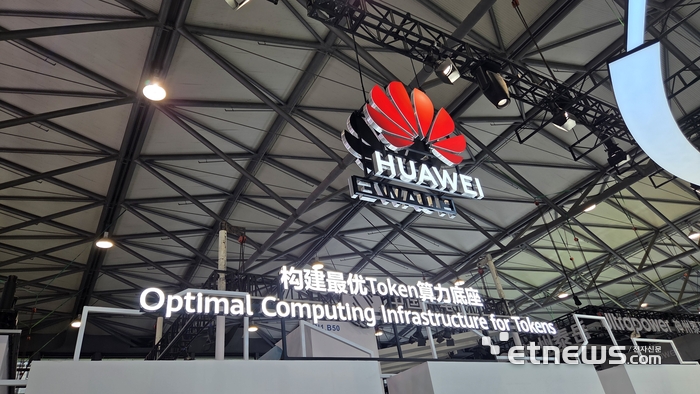
The Ascend series is a neural processing unit (NPU) for AI computation independently developed by Huawei. Following the first launch of the Ascend 910C model last year, the company entered mass production of the follow-up model, Ascend 950PR, last April. It plans to release the Ascend 950DT, which is specialized for AI training, during the fourth quarter of this year. Equipped with self-developed high bandwidth memory (HBM), it is a product counted as an achievement of the Chinese semiconductor industry amid the U.S. isolation policy against China.
In the Korean market, the simultaneous launch of the Ascend 950DT and 950PR in the fourth quarter is highly probable. Huawei plans to provide an all-in-one package, including not only single chips but also the Atlas 950 SuperPod, an AI computing system equipped with them. This product is configured as one massive AI computing infrastructure, mounting up to 8,192 Ascend chips.
For sales channels in the Korean market, it is known that the company has selected two companies, including its existing partner SK shieldus. It is judged that they are suitable as partners for entering the domestic NPU market since they have experience in distributing major Huawei products and technical know-how.
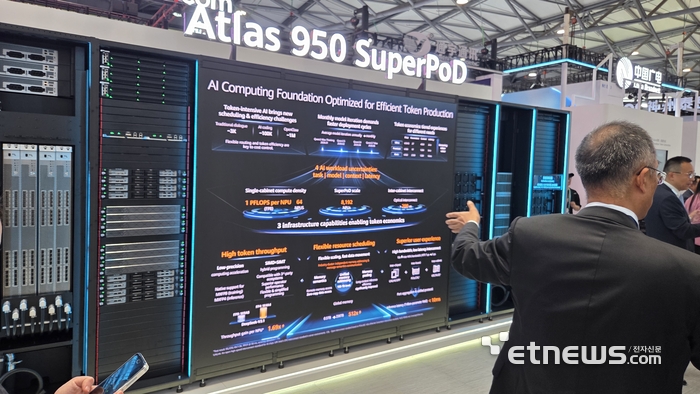
Huawei Korea is expected to engage in 'De-Nvidia' marketing, emphasizing the performance and price competitiveness of the Atlas 950 SuperPod equipped with Ascend chips. In fact, Huawei has previously stated that based on the Ascend 950PR model, it provides about 2.87 times higher computing performance in the inference domain compared to Nvidia's graphics processing unit (GPU) 'H20', and the price is about one-fourth the level. The company emphasizes that although performance falls behind when compared to Nvidia's flagship GPU 'H200', this can be resolved through the Atlas 950 series, which connects thousands of chips.
The Ascend 950PR is being adopted by big tech companies successively, such as being utilized for 'DeepSeek-V4'. Huawei is gaining confidence as it has improved compatibility with Nvidia's programming language 'CUDA', which was an obstacle to expansion, through its own network technology. Based on this, the design is to turn its eyes even to the Korean market, where demand for AI infrastructure is surging, and to establish itself as an alternative to resolve Nvidia dependency and price burdens.
From some corners of the industry, observations also come out that domestic sentiment sensitive to the introduction of Chinese technology and products, and power consumption issues due to heat generation, will become obstacles to Huawei settling into the Korean AI market.
Huawei Korea replied to this paper's request for coverage, “We cannot comment regarding the product launch.”
