



Development of NCF and MUF Materials Underway
Customized Solutions to Meet Customer Needs
Reducing Dependence on Japan, Diversifying Supply Chains
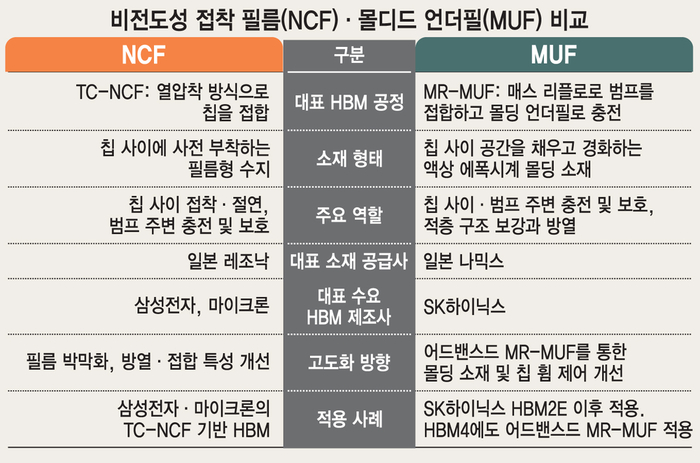
LG Chem has begun developing materials for the mass reflow-molded underfill (MR-MUF) process, which is essential for manufacturing high-bandwidth memory (HBM). Following its development of nonconductive film (NCF), used to bond DRAM chips together to produce HBM, the company is expanding its efforts to localize key HBM materials by developing materials for the MR-MUF process.
The move is expected to diversify the supply chain for HBM bonding materials, which has long depended on Japan, while allowing LG Chem to expand its customer base in the HBM materials market.
According to industry sources on Nov. 11, LG Chem is developing molded underfill (MUF) bonding materials for the MR-MUF process in addition to its existing NCF development efforts. Both are essential materials for HBM manufacturing.
HBM is an advanced memory technology that maximizes data processing performance by vertically stacking DRAM chips. It is considered a leading type of artificial intelligence (AI) memory. During HBM manufacturing, bonding materials fill microscopic gaps between chips and protect the bonded interfaces, playing a crucial role in the stability of the stacked structure and heat dissipation performance. As the number of HBM layers increases, the gaps between chips become narrower, making materials development significantly more challenging.
Samsung Electronics and Micron Technology use NCF in film form, applying heat and pressure to bond the chips. LG Chem has developed NCF using its proprietary technology and is currently undergoing evaluations by major customers. The company has reportedly made significant technological progress recently and received favorable evaluation results.
SK Hynix manufactures HBM using the MR-MUF process, in which chips are first stacked, their electrodes are bonded simultaneously, and a liquid protective material is then injected and cured. The MUF material being developed by LG Chem is designed for this process.
LG Chem can target demand from Samsung Electronics and Micron with its NCF products while expanding its business to potential customers, including SK Hynix, by securing liquid MUF materials. The move is a strategic effort to establish customized solutions capable of supporting both types of manufacturing processes used by its customers. It could also provide an opportunity for the company to extend capabilities accumulated in its existing semiconductor materials business into the cutting-edge HBM sector.
The development is also significant in terms of strengthening South Korea's domestic supply chain independence. Currently, NCF used by Samsung Electronics is primarily supplied by Japan's Resonac, while MR-MUF materials used by SK Hynix are supplied by Japan's NAMICS. If LG Chem successfully develops these materials, HBM manufacturers such as Samsung Electronics and SK Hynix could reduce their dependence on Japanese suppliers and diversify their supply chains.
LG Chem is expected to conduct performance evaluations and reliability verification tailored to customers' manufacturing processes as it continues developing the materials.
“Although South Korean semiconductor companies lead HBM manufacturing, they still depend heavily on overseas suppliers for many key materials,” an industry official said. “If LG Chem succeeds in mass-producing and supplying NCF and MR-MUF materials, it could create an opportunity to strengthen the domestic supply chain.”
