

China's three leading home appliance manufacturers have all entered the artificial intelligence data center (AIDC) cooling market, which Samsung Electronics and LG Electronics have identified as their next growth engine beyond home appliances.
The Chinese companies are rapidly catching up with their South Korean rivals by joining Nvidia's ecosystem and leveraging production bases in Southeast Asia. After facing competition from Chinese manufacturers in home appliances and televisions, Samsung and LG now face a similar challenge in AIDC cooling.
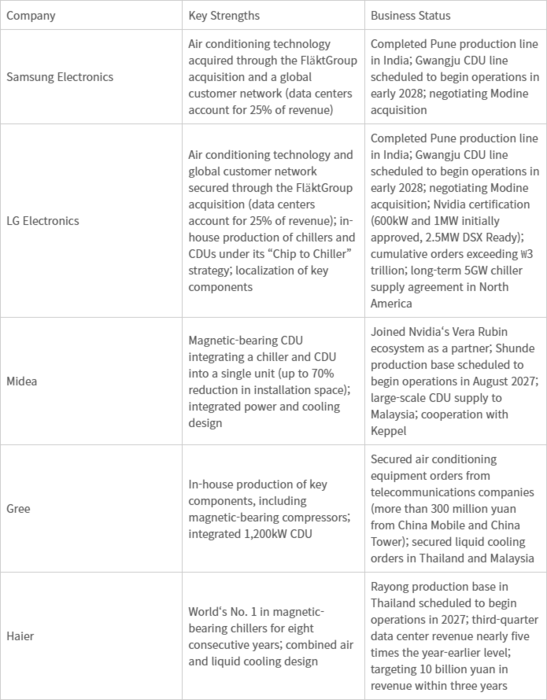
Midea was named among the MGX ecosystem partners for Nvidia's next-generation Vera Rubin platform, unveiled at the OCP Global Summit in the United States last month. Its liquid cooling production base in Shunde, built with an investment of more than 1 billion yuan (approximately KRW200 billion), is scheduled to begin operations in August 2027.
The company has supplied large quantities of magnetic-bearing coolant distribution units (CDUs) to data centers operated by major cloud service providers in Southeast Asia and is targeting the Asia-Pacific market in partnership with Singapore's Keppel. In June, it also signed a strategic agreement with Alibaba on AIDC liquid cooling.
Gree is leveraging its strength in manufacturing key components, including magnetic-bearing compressors, in-house. In June, it introduced an integrated CDU with a capacity of up to 1,200 kilowatts (kW) and secured orders for liquid cooling systems at data centers in Thailand and Malaysia. This month, it won orders worth more than 300 million yuan (approximately KRW60 billion) from China Mobile and China Tower for air conditioning equipment used in data centers and base stations.
Haier is building an air conditioning production base in Rayong, Thailand, with an investment exceeding 1 billion yuan. Scheduled to begin operations in 2027, the facility will mass-produce magnetic-bearing cooling systems and CDUs.
The company supplied 48 magnetic-bearing chillers to a major data center in Malaysia, reducing its power usage effectiveness (PUE) from 1.45 to 1.38. It has also supplied equipment to data centers in Singapore.
Haier's data center revenue in the third quarter surged to nearly five times the level recorded a year earlier. The company is targeting 150% growth this year and aims to reach 10 billion yuan in revenue within three years.
A common competitive advantage among the three Chinese companies is their integrated solutions combining chillers and CDUs. Midea has introduced a magnetic-bearing CDU that integrates the two components, reducing installation space by up to 70%. The strategy directly overlaps with LG Electronics' “Chip to Chiller” approach.
The companies are also competing in the same markets. Chinese manufacturers are stepping up their expansion in Southeast Asia, a key target market for Samsung Electronics and LG Electronics, by leveraging local production facilities.
However, none of the three Chinese companies has disclosed liquid cooling revenue, and all are planning large-scale shipments for 2027 to 2028. This gives Samsung Electronics and LG Electronics a window of one to two years.
The two South Korean electronics giants are taking different approaches.
Samsung Electronics completed its acquisition of Germany's FlaktGroup for 1.5 billion euros (approximately KRW2.34 trillion) in November last year. The deal was Samsung's largest merger and acquisition since Harman, and data centers account for 25% of FlaktGroup's revenue.
Samsung has integrated the organizations by having the head of its heating, ventilation and air conditioning (HVAC) business team concurrently serve as CEO of FlaktGroup Korea. It also completed a production line in Pune, India, in August.
More recently, Samsung recruited Kim Hyung-wook, a former Schneider Electric executive, as vice president and is reportedly negotiating the acquisition of U.S.-based Modine. Its strategy is to absorb as many external resources as possible.
A CDU production line in Gwangju, which will require an investment of KRW240 billion, is scheduled to begin operations in early 2028.
LG Electronics, meanwhile, is entering Nvidia's supply chain by leveraging its proprietary technology.
Led by its chiller business, LG Electronics' cumulative AIDC cooling orders exceeded KRW3 trillion through the third quarter. Growth was driven by a long-term agreement to supply chillers with a combined capacity of 5 gigawatts (GW) to U.S.-based Air Control Concepts. The companies are also discussing expanding the range of supplied products to include CDUs.
LG Electronics' 600kW and 1-megawatt (MW) CDUs received Nvidia specification approval in July and September, respectively. Its 2.5MW CDU subsequently met additional requirements and received “DSX Ready” approval. The company plans to expand certification to CDUs with capacities of up to 4MW.
“The results of the AIDC cooling business, where South Korean and Chinese companies are competing head-to-head, will begin to emerge in earnest next year,” an industry official said. “The competitive landscape between South Korean industry leaders and Chinese challengers in home appliances is expanding into advanced technology sectors.”