




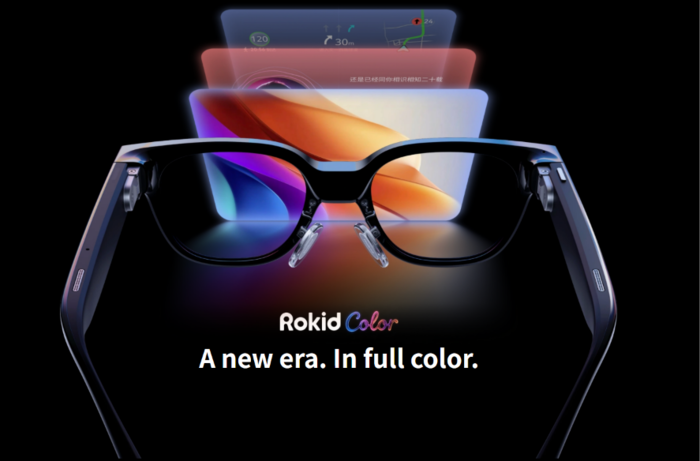
China is advancing in the AR device market by equipping both lenses of its devices with RGB full-color micro-LEDs, considered a next-generation display technology. Concerns are rising that Chinese companies, which have vertically integrated their supply chains from materials and components to finished products, may dominate the micro-LED market for AR glasses.
According to industry sources on the 15th, Chinese company Rokid recently unveiled its new smart glasses, 'Rokid Color,' which applies full-color micro-LED displays to both eyes.
The product incorporates an ultra-compact micro-LED optical engine with a volume of just 0.16cc. Excluding the nose pad, the main body weighs approximately 55g. Rokid plans to officially launch the product in the Chinese domestic market in April next year.
Another Chinese company, RayNeo, has also introduced the 'iO+' smart glasses equipped with full-color micro-LEDs.
In the AR smart glasses display market, the 'LCoS' (Liquid Crystal on Silicon) method, which layers liquid crystals on a silicon wafer, has been dominant. This is due to its advantages in RGB color reproduction, resolution, cost competitiveness, and mass production stability over other micro-display technologies. For instance, Meta's 'Meta-Ray-Ban Smart Glasses,' which achieved commercial success last year, adopted a full-color LCoS panel in one lens.
However, micro-LEDs are highly regarded as the ultimate display for AR devices due to their superior brightness, lifespan, and power efficiency, which are critical for outdoor visibility. Nevertheless, the high technical difficulty of the manufacturing process and low maturity in achieving high resolution have limited their application to monochrome green displays. Implementing full-color RGB micro-LEDs in AR devices requires bulky optical engines like the 'X-Cube,' which combines three color lights, making it challenging to miniaturize and lightweight the glasses.
As Chinese companies continue to release binocular full-color LED devices, analysis suggests that their supply chains—from micro-LED chip miniaturization to ultra-compact optical design technology—are rapidly maturing.
An industry insider stated, “While micro-LEDs are also considered a next-generation growth engine in South Korea, technological development and related production infrastructure remain weak, and market prospects are unclear, leading to low urgency.” They added, “There are concerns that once the market opens, Chinese companies may monopolize it, from core component supply chains to the entire ecosystem of finished products.”
