






Dell became the leading PC vendor in the U.S. market in the first quarter, surpassing HP in terms of shipments. Despite an overall market decline driven by soaring memory chip prices and ongoing component supply constraints, Dell's strong performance in the commercial PC segment helped propel it to the top position.
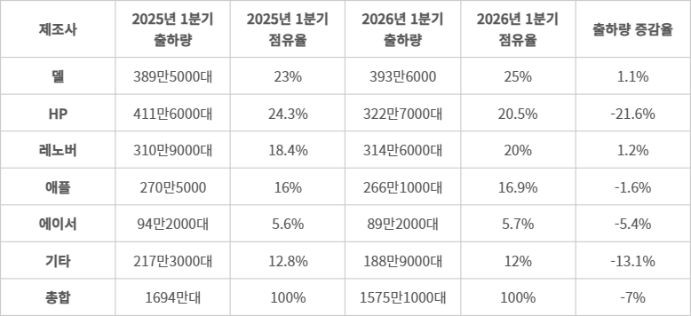
According to market research firm Omdia, Dell shipped 3.936 million desktop and notebook PCs in the U.S. during the first quarter, capturing a 25% market share. Its shipments increased 1.1% year over year, while its market share rose by 2 percentage points.
HP, which ranked first during the same period last year, saw its first-quarter shipments fall 21.6% year over year to 3.227 million units. Its market share declined from 24.3% to 20.5%, allowing Dell to overtake it as the market leader.
Lenovo and Apple ranked third and fourth, shipping 3.146 million and 2.661 million units, respectively. Taiwan-based Acer placed fifth with shipments of 892,000 units.
Dell's rise to the top of the U.S. market is largely attributed to its strength in the commercial PC segment. The U.S. PC market shipped a total of 15.751 million units in the first quarter, down 7% from a year earlier due to worsening supply chain disruptions. Consumer PC shipments were hit particularly hard, declining 9.5% amid rising component costs and persistent inflation, compared with a 5% decline in commercial PC shipments. Shipments of entry-level PCs priced below $500 fell 18.7%.
Dell has long maintained a strong position in the commercial PC market, offering a portfolio of desktops and notebooks focused on high-value business-to-business (B2B) customers. This positioning enabled the company to capture continued demand for enterprise PC upgrades despite the broader market slowdown, allowing it to sustain growth while competitors struggled.
HP, by contrast, has a relatively larger exposure to the consumer PC segment, making it more vulnerable to component shortages and rising manufacturing costs. Analysts believe these factors contributed directly to the company's decline in market share.
The sharp rise in memory semiconductor prices has created a widening performance gap among PC vendors. As investments in artificial intelligence (AI) infrastructure continue to accelerate, demand for semiconductors has surged, driving prices of commodity DRAM and NAND flash memory up by more than 700% and 800%, respectively, since the second half of last year.
Omdia noted that memory supplies are increasingly being prioritized for AI servers, pushing up the cost of mainstream components while squeezing profit margins for entry-level devices. As a result, the competitiveness of low-cost PCs has weakened. The research firm forecasts that persistent memory shortages will cause U.S. PC shipments to decline by 14.4% year over year in 2025.
“Memory supply constraints are expected to continue at least through next year, placing further pressure on manufacturers' profitability,” an industry official said. “How effectively vendors respond to ongoing supply shortages will be a key factor determining their market share and shipment performance.”