








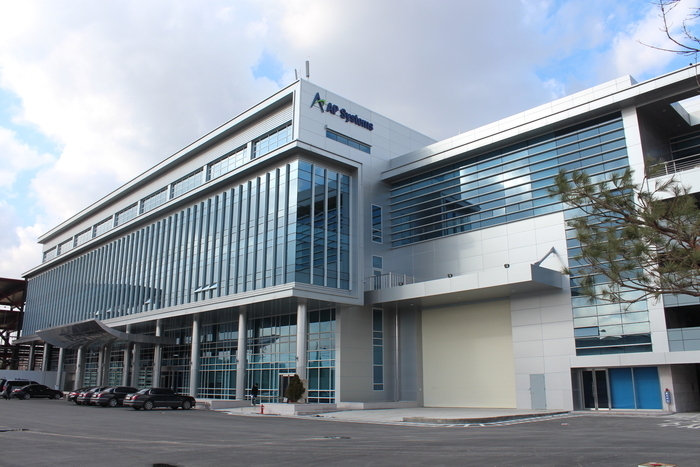
AP Systems is pushing to expand its display equipment business by developing next-generation tools that have yet to be adopted in commercial organic light-emitting diode (OLED) mass production. If successfully integrated into high-volume manufacturing lines, these new tools are expected to serve as a powerful new growth engine for the company's display division.
According to industry sources on July 6, AP Systems is currently refining and upgrading its new display equipment lineup, which features plasma-enhanced atomic layer deposition (PEALD) systems and module-level optical clear resin (OCR) inkjet printers.
While ALD technology--capable of depositing thin films with atomic-level precision--is widely commercialized in the semiconductor sector, its footprint in the display industry remains minimal. AP Systems has been developing ALD equipment for years without hitting a mass-production milestone. However, the recent emergence of High-Mobility Oxide (HMO) as a next-generation OLED thin-film transistor (TFT) architecture has cast a spotlight on ALD's ability to drastically boost electron mobility, opening up a fresh market opportunity for the equipment maker.
HMO is an advanced drive-circuit TFT technology engineered to deliver significantly faster electron mobility than conventional oxide TFTs. Touted as a potential successor to low-temperature polycrystalline oxide (LTPO)--the current dominant technology in premium smartphones--HMO offers superior low-power performance while elevating overall oxide TFT capabilities. An AP Systems official noted, “Applying ALD technology yields much higher electron mobility compared to traditional sputter systems, enabling the production of ultra-high-resolution OLED panels.”
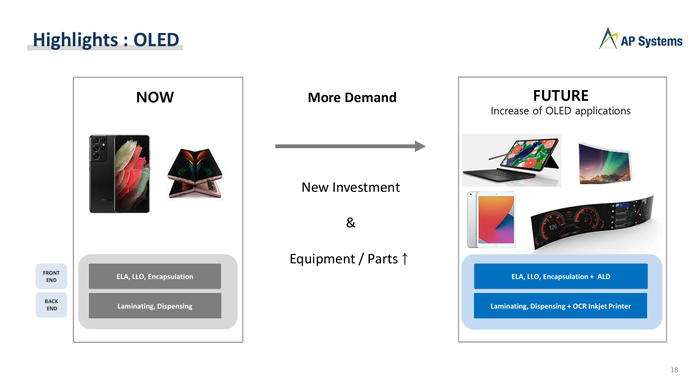
For the display module back-end process, AP Systems is betting on its new OCR inkjet printers. Currently, OLED module lamination relies heavily on film-type optical clear adhesives (OCA). In contrast, the OCR approach jets liquid resin precisely where needed to bond multiple layers, a technique recognized for slashing raw material costs and streamlining processing steps. Like ALD, OCR inkjet systems represent a frontier technology yet to be deployed in commercial OLED mass production, and the company is actively knocking on the doors of major panel makers to secure adoption.
Currently, AP Systems relies on its mainstay cash cows: Laser Lift-Off (LLO), Excimer Laser Annealing (ELA), and back-end lamination equipment. LLO is a mission-critical tool for manufacturing flexible OLEDs, while ELA is indispensable for driving LTPS and LTPO panel performance. Its existing lamination tools primarily handle film-based bonding in the module stage, making the transition to liquid OCR a strategic evolution for the firm.
