






Controversy over single-stock leveraged products tracking heavyweight names like Samsung Electronics and SK hynix has spilled into South Korea's National Assembly, with critics arguing the instruments are distorting demand for large-cap shares and fueling intraday volatility.
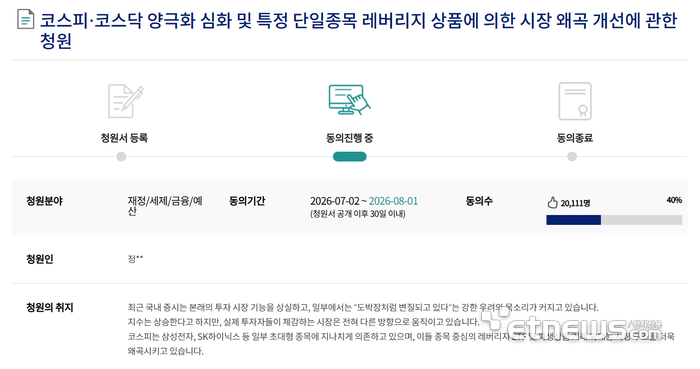
According to a petition filed with the National Assembly's public petition system on July 9, the “Petition on Addressing KOSPI-KOSDAQ Polarization and Market Distortion Caused by Single-Stock Leveraged Products” gathered more than 20,000 signatures within a week of being posted. The petitioner argued that while the KOSPI index keeps climbing, that rally doesn't match what individual investors are actually feeling in the market -- and that capital piling into a handful of large-caps and their associated leveraged products is warping the market's underlying structure.
At the center of the dispute are single-stock leveraged and inverse ETFs and ETNs, first introduced in Korea in late May. These products are designed to track twice -- or twice inverse -- the daily return of a single underlying stock. Gains are amplified when the stock rises, but losses are just as amplified when it falls. Regulators, aware the products carry more risk than conventional leveraged funds, built in safeguards from the start: a minimum deposit of 10 million won, mandatory investor education, and stricter product-naming rules.
The trouble is that money flowed in far faster than expected. In the seven trading days after the Samsung Electronics and SK hynix single-stock leveraged products listed, cumulative trading value across all 14 leveraged tickers hit 58 trillion won, with retail investors net-buying 7.4 trillion won worth. Over that same stretch, semiconductor names accounted for 79% of all retail net buying across Korean equity ETFs -- meaning retail ETF money was, in effect, funneling almost entirely into Samsung Electronics and SK hynix.
The concentration didn't let up. Per the Korea Capital Market Institute, retail investors net-bought roughly 8.2 trillion won of Samsung Electronics and SK hynix single-stock leveraged ETFs between May 27 and June 19, while inverse ETFs pulled in about 300 billion won. Leveraged ETF buying skewed even more heavily toward SK hynix (4.6 trillion won) than Samsung Electronics (3.7 trillion won).
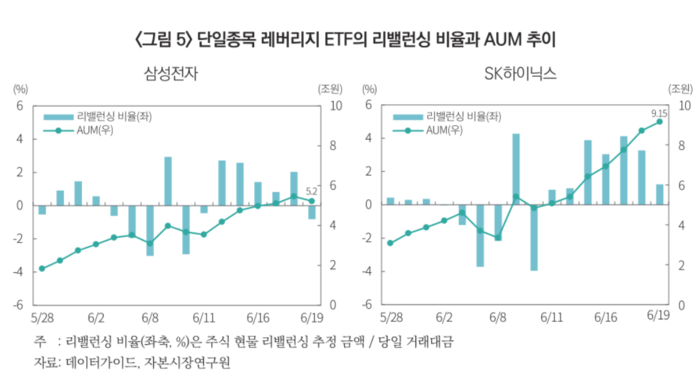
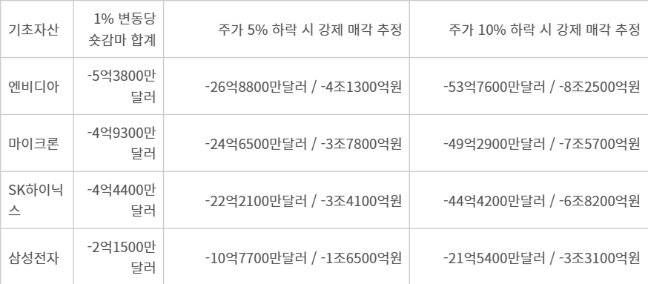
The outsized volatility stems from what's known as a “short gamma” structure. To hit their daily target multiple, single-stock leveraged ETFs must rebalance their underlying stock or futures positions every day -- buying more when the price rises and selling more when it falls. That mechanical rebalancing can amplify momentum in both directions: adding fuel to rallies and adding pressure to selloffs.
The risk is magnified when that rebalancing demand concentrates in index heavyweights like Samsung Electronics and SK hynix. A supply-demand shock in a single stock can ripple out into broader volatility across the KOSPI 200 and the KOSPI as a whole, and as assets under management in these products grow, so does the trading pressure around the market close.
With the petition now in play, pressure is mounting on regulators and the exchange to revisit the framework governing these products -- including listing standards, eligibility criteria for underlying assets, oversight of rebalancing trades, market maker obligations, tracking-error management, risk disclosures, and investor suitability rules.
“Single-stock leveraged ETFs can support market liquidity by boosting trading activity, but they can also make investing harder to navigate during periods of heightened volatility,” said Park Woo-yeol, chief researcher at Shinhan Investment Securities. “Investors need to fully understand the structure and risk profile before getting involved.”