






In the domestic automobile market during the first half of the year, new EV registrations surged more than twofold compared to the previous year, recording explosive growth. While hybrids, which had led the market for a while, entered a breathing spell, EVs are taking shape as the mainstream by quickly absorbing demand for hybrids and internal combustion engine vehicles.
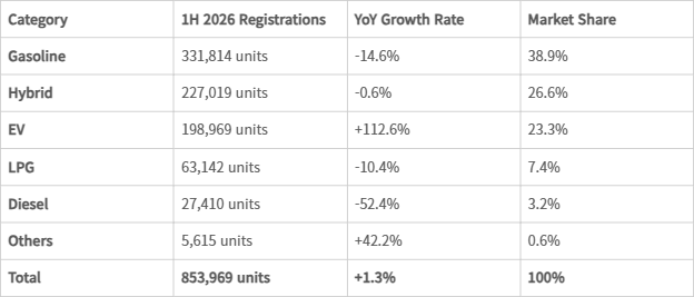
According to the CarIsYou Data Research Institute on July 12, the number of EV registrations in the first half of the year stood at 198,969 units, which was tallied as an explosive 112.6% increase compared to the same period last year (93,568 units). Accordingly, the EV market share of new cars in the first half of the year rose to 23.3%. This is a level close to one out of every four new cars registered in the country.
On the other hand, hybrid vehicles, which had led the market for a while, stopped at 222,719 units registered in the first half of the year, decreasing by 0.6% compared to the same period last year. Gasoline vehicle registrations also stopped at 331,814 units, shrinking by 14.6% compared to the same period last year.
While hybrids faltered, EVs sprinted, narrowing the market share gap between the two sides. In the first half of last year, the market share gap between hybrids (27.1%) and EVs (11.1%) was 16.0%p, but in the first half of this year, they recorded 26.6% and 23.3% respectively, narrowing to a 3.3%p difference. EVs are chasing right under the chin of hybrids by reducing the gap by as much as 12.7%p within one year.
Backed by this growth of EVs, the sales proportion of eco-friendly cars combining hybrids and hydrogen exceeded 50% for the first time. The EV craze is analyzed as a result of the successful market settlement of domestic entry-level models coupled with the aggressive volume offensive of imported EV brands.
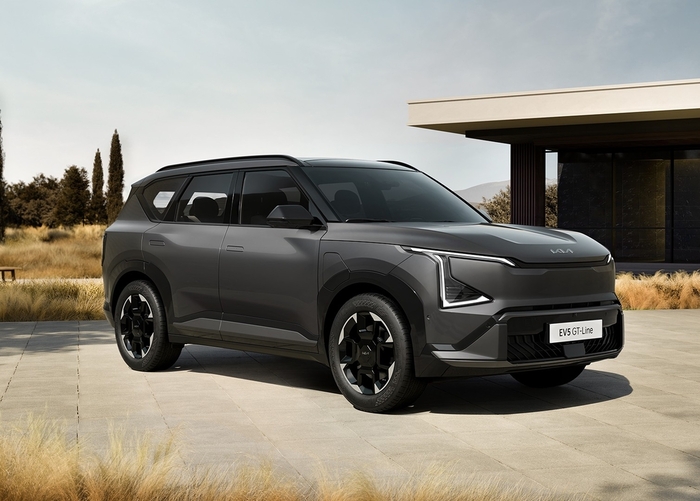
In the domestic passenger car market, the entry-level lineup EV3 (18,009 units) and EV5 (15,411 units) introduced by Kia drove growth by placing their names side-by-side in the top ranks of domestic cars in the first half of the year. Hyundai Motor Company also added strength with the Ioniq 5 (11,569 units) and the large SUV Ioniq 9 (7,002 units).
In the imported car market, EVs completely shook up the판도 (landscape). Tesla registered 5,6147 units in the first half of the year alone, an emergency 192.1% jump compared to the same period last year, surpassing BMW and Mercedes-Benz to rise to number one overall among imported car brands. In particular, 43,361 units of the Tesla 'Model Y' were registered, taking number one among single models of imported passenger cars.
The BYD blast was also powerful. BYD registered 11,675 units in the first half of the year, leaping over traditional powerhouses such as Lexus, Volvo, and Audi to leap to fourth place among imported car brands. The entry-level models 'Dolphin' (4,511 units) and 'Sealion 7' (4,477 units) settled into sixth and seventh place respectively in the rankings by imported passenger car model, opening the floodgates for popularization.
This steep growth trend of EVs is raising the possibility of achieving the zero-emission vehicle supply roadmap being promoted by the government. In the automobile industry, positive outlooks are emerging that if the steep electrification transition trend like the first half of this year continues as it is, achieving the government-announced goal of 'a 50% share of zero-emission vehicles among domestic new car sales by 2030' will be smooth.
An automobile industry official said, “As the price burden, which had been pointed out as an obstacle to the popularization of EVs, is offset by the appearance of various entry-level models, concerns over a 'chasm' are disappearing,” adding, “Because consumer footsteps that were heading toward hybrids are turning to EVs, the electrification paradigm shift in the domestic automobile market will accelerate further.”