







“Using Financial Resources for the Golden Time of AI Hegemony”
Intensive Investment in Youth, Regions, and Talents
Next Year's Expenditures Projected at 800 Trillion KRW + α
An Increase of More Than 10% Compared to This Year
The government will create a 'Future Response Fund' using additional tax revenues collected from the semiconductor super-boom, and invest on a large scale in future growth engines and the youth. In addition, the government announced expenditure restructuring and large-scale fiscal injections into three major mega-projects, while promising active administration tailored to corporate needs, fiscal support, and infrastructure construction.
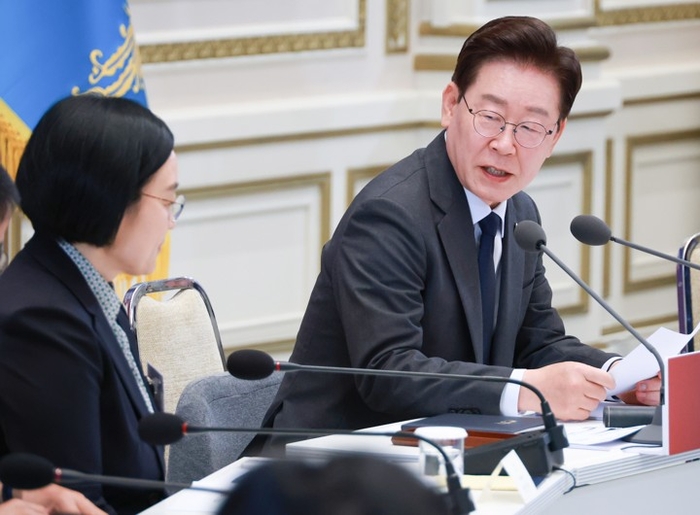
President Lee Jae-myung presided over the National Fiscal Strategy Meeting under the slogan “An Irreplaceable Republic of Korea Opened Through Bold Innovation and Investment” at the Blue House Guest House on the 13th and said, “We will utilize the large-scale additional tax revenue as financial resources for strategic investment to respond to the future.”
Lee disclosed a blueprint to create a 'Future Response Fund' with the additional tax revenue resulting from the semiconductor super-boom. The plan is to accumulate the large-scale tax revenue increase that exceeds long-term trends into the fund, and invest it in four major focus areas: △youth, △growth engines, △regions, and △talents. This means that the government will intensively inject funds into expanding the future, youth, and social safety nets by utilizing the Future Response Fund, which will serve as an investment platform and play a role in mitigating tax revenue volatility.
“The additional tax revenue is precious financial resources to be spent during the golden time when global artificial intelligence (AI) hegemony is decided,” Lee emphasized. “We will intensively invest the Future Response Fund into four major areas that will determine the nation's future, and through this, we will raise the economy's growth potential and return the fruits to all citizens.”
He also added, “To do this, we need a strategic investment platform that guarantees bold and continuous investment in the future. The Future Response Fund will perform this function,” and “It will become a stepping stone to achieve a great leap forward together with the future generation.”
Large-scale investments will also be made in the 'Three Major Mega-Projects' previously announced by the government, such as △semiconductors, △physical AI, and △AI data centers. The government plans to spare no possible policy support, especially for the success of the Honam region semiconductor cluster.
“We will turn the three major mega-projects into a new opportunity for our economy,” Lee promised. “We will fully mobilize the government's capabilities and provide concentrated support so that investments can be made according to companies' timetables.” In particular, he stated, “The stable supply of power and water, which are essential resources, is basic, and we will establish new growth hubs for the Republic of Korea by building residential, educational, medical, and cultural living conditions and innovation foundations, in addition to expanding transportation, logistics, and infrastructure.”
To resolve human alienation caused by the development of AI and other factors, the government will also move to expand social safety nets. In addition, a support system for the youth generation, who have faced relative difficulties, will be established.
“We will create a Republic of Korea where no one is alienated through the growth of everyone,” Lee explained. “For young people taking their first steps into society, we will establish a support system spanning their entire life cycle, from jobs to housing and asset formation.”
He also added, “We will further strengthen the social safety net to the level of a social safety mat so that atypical workers, whose numbers will inevitably increase in the AI era, can be tightly protected,” and “The government will do its best to provide daily support so that all citizens can fully enjoy the benefits of artificial intelligence technology advancement.”
Fiscal expenditures will also be significantly increased. Park Hong-geun, minister of the Ministry of Strategy and Budget, announced on this day that the government expenditure plan for the 2027 fiscal year would be formulated at a scale of '800 trillion KRW + α', an increase of more than 10% compared to this year. Along with this, he foreshadowed a massive expenditure restructuring, including △a 15% reduction in discretionary spending, △a 10% reduction in mandatory spending, and △a 10% abolition and full cut of projects. Through this, the government envisions improving fiscal efficiency while simultaneously securing investment capacity for future growth engine sectors.
