









The research and development (R&D) projects of the Korea AeroSpace Administration (KASA) recorded weak execution performance last year. While much of the shortfall was attributed to delays in project implementation procedures, concerns are growing that the accumulation of unspent budget allocations is affecting overall government fiscal management, underscoring the need for improvements.
In its recently published report, Analysis by Standing Committee of the FY2025 Settlement of Accounts - Ministry of Science and ICT, the National Assembly Budget Office criticized KASA for its low R&D budget execution rate and sluggish progress in carrying out key projects.
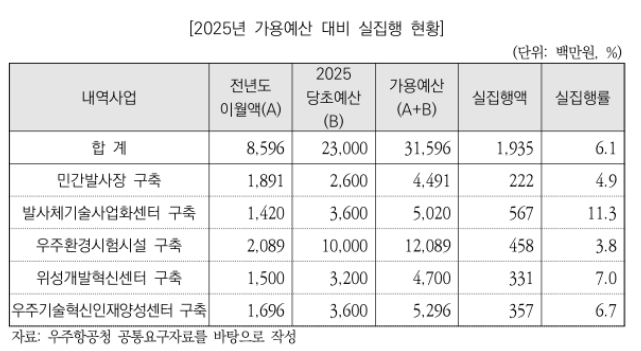
A representative example is the Space Industry Cluster Triangle Initiative, which aims to develop Goheung County as a launch vehicle hub, Jinju and Sacheon as satellite hubs, and Yuseong District as a national space research cluster. The budget authority allocated a total of KRW 31.596 billion to the project in 2024 and 2025, but KASA executed only KRW 1.935 billion, or 6.1% of the budget. Most of the spending went toward personnel costs, while execution of the research facilities and equipment budget for the Satellite Development Innovation Center stood at just 0.5%.
KASA attributed the poor budget execution to delays in reviewing the project's feasibility and implementation plan. During the 2024 review process, responsibility for managing the cluster project was shifted from an outsourced program office to direct oversight by KASA. The prolonged transition delayed preparatory work, including procurement procedures for research equipment.
The National Assembly Budget Office, however, argued that the unspent funds represented a missed opportunity to redirect resources to other fiscal programs where they could have generated greater benefits. It also warned that continuing to allocate and disburse budgets as originally planned despite slow project progress could distort spending priorities and undermine the efficiency of government fiscal management.
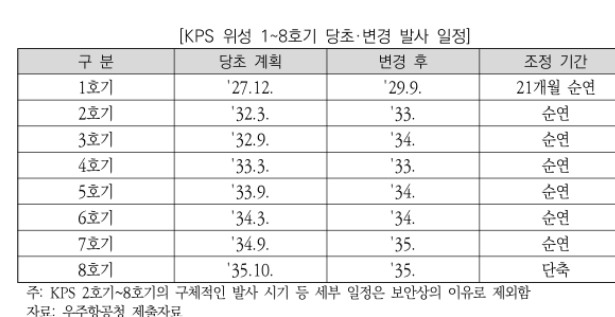
Delays to satellite development projects also came under scrutiny. A multi-agency initiative to deploy satellites for the Korean Positioning System (KPS) over the Korean Peninsula--providing high-precision positioning, navigation, and timing (PNT) services--has seen the launch of its first satellite pushed back by 21 months, from December 2027 to September 2029. The project's actual budget execution rate has also remained in the 60-70% range for four consecutive years. Despite these delays, KASA has announced plans to accelerate the launch schedule for the system's eighth satellite.
The National Assembly Budget Office urged KASA to assess the feasibility of shortening the launch schedule for the remaining satellites and to examine the structural causes behind the low execution of research activity and equipment budgets. In the Small Satellite Constellation Development Program, the launch plan was changed from using a foreign launch vehicle to a Korean-developed rocket. The office recommended considering an early settlement and return of the now-unnecessary overseas launch budget.
Budget overlap and implementation delays were also identified in newly launched R&D programs last year. The Innovative Reusable Launch Vehicle Core Technologies project was allocated KRW 5 billion in 2025 but was suspended after it was found to overlap with a program managed by the Defense Acquisition Program Administration (DAPA).
The Budget Office also called for reforms to KASA's exploratory research program, which is designed to identify R&D demand in the aerospace sector and evaluate potential large-scale national projects. Because many research contracts are awarded late in the year and project completion is often scheduled after the following year's budget request deadline, the findings cannot be effectively incorporated into new R&D planning and budget formulation.
“The purpose is not simply to commission and complete research projects,” the Budget Office said. “The key is to use the findings to plan new R&D programs and inform budget allocation. Project schedules should therefore be designed so that final deliverables align with the timeline for the following year's budget requests.”
