








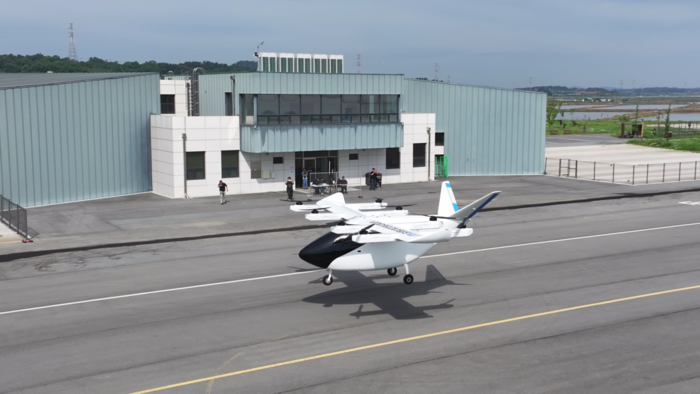
As the South Korean government pushes toward the commercialization of Urban Air Mobility (UAM) services by 2028, a domestically developed UAM aircraft built by a private Korean company will be unveiled to the public for the first time. Following the government's announcement in March of plans to build vertiports for urban demonstration projects in the Seoul metropolitan area, the debut of a homegrown aircraft marks K-UAM's transition from infrastructure development to the validation of real-world operational systems.
The Ministry of Land, Infrastructure and Transport (MOLIT) announced on July 14 that it will host the K-UAM Flight Showcase on July 15 at the INU Innovation Center of Incheon National University. The event will take place ahead of the 2026 Korea Drone & UAM Expo, scheduled to be held from July 15 to 17 at Songdo Convensia in Incheon.
At the showcase, a UAM aircraft under development by Sambo Motors Group will be presented to the public for the first time. It marks the first public unveiling of a domestically developed UAM aircraft by a Korean private company.
During the demonstration, the aircraft will perform a remotely piloted vertical takeoff followed by a hovering flight at an altitude of approximately five meters. The flight will showcase its flight control technology, electric propulsion system, and safety management capabilities. The developer will also provide an update on the aircraft's development progress, and attendees will have an opportunity to inspect the aircraft up close.
The unveiling aligns with the government's roadmap for commercializing K-UAM. Since 2023, MOLIT has been conducting flight demonstrations in open-air environments at the Goheung National Integrated Flight Test Center in South Jeolla Province. Beginning this year, the ministry is advancing to the second phase of testing by establishing an urban vertiport near KINTEX in Goyang, Gyeonggi Province.
The site will be developed in stages into a commercial-scale UAM facility equipped with landing and takeoff pads, passenger terminals, and hangars. It will serve as a testbed for evaluating safety and operational systems under actual urban flight conditions.
The government believes that preparations for K-UAM commercialization have entered a full-scale phase as infrastructure development--including vertiports, traffic management systems, communications and air traffic control systems, and operational regulations--progresses alongside private-sector aircraft development. It has also expanded commercialization efforts by launching pilot demonstration programs and initiating Korea's first training projects for UAM pilots and maintenance technicians.
“With the goal of commercializing UAM by 2028, we will place the highest priority on safety while conducting phased verification from simple to increasingly complex flight operations,” said Kim Yoon-deok, Minister of Land, Infrastructure and Transport. “We hope the challenges undertaken by Korean companies will soon lead to a new mode of transportation that transforms people's everyday lives.”
