









Anthropic disclosed a research result on the 13th (local time) showing that the values expressed by its artificial intelligence (AI) model 'Claude' during conversations change systematically depending on the model version and the language used.
The company analyzed approximately 310,000 actual conversations to derive four core axes. The four axes are 'Compliance vs. Prudence,' which looks at whether it accepts the user's demands as they are or guards against the possibility of risk and harm; 'Warmth vs. Rigor,' an indicator of whether it prioritizes a positive attitude and consideration or accuracy and precision; 'Depth vs. Conciseness,' which looks at whether it explains in depth or handles only what was requested; and 'Candor vs. Executive Function,' an indicator of whether it reveals uncertainty or provides confident answers.
Differences in personality by model were confirmed through data. 'Sonnet 4.6' showed relatively prominent acceptability and warmth, 'Opus 4.6' showed rigor and directness, and 'Opus 4.7' showed prudence, depth, and candor.
Anthropic stated that these results align with the subjective impressions inside and outside the company that have evaluated Sonnet 4.6 as a model that gives a warm feeling and Opus 4.7 as a 'strict model.'
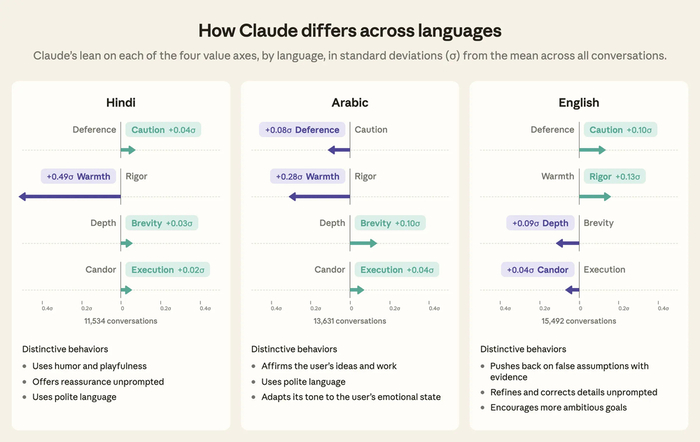
Differences by language also existed. The research team conducted the same analysis on the 20 most frequently used languages in Claude, and as a result, it was confirmed that the values emphasized by Claude differed depending on which language the same question was asked in. For example, warmth appeared relatively high in Hindi and Arabic, while rigor appeared relatively high in English and Russian.
In the case of Korean, as a result of analyzing more than 15,570 conversations, acceptability, warmth, and candor appeared somewhat high compared to the average of the 20 languages, and the most prominent characteristic was conciseness. In addition, tendencies were confirmed where it provides empathy and comfort rather than judging the user, naturally matches the user's tone and level of honorifics, and uses humor and playful expressions.
Anthropic explained that through this study, it has presented a new methodology to evaluate value profiles before a model's release and to continuously monitor them in actual service environments even after the release.
