







“In the 1970s, Britain squandered the immense wealth of its North Sea oil fields on short-term consumption and fiscal spending instead of productive investment in future industries, ultimately suffering the 'resource curse' of eroded manufacturing competitiveness.”
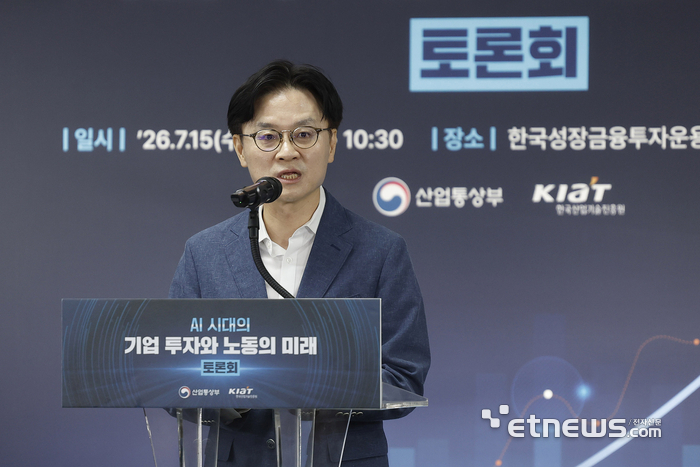
Industry Minister Kim Jung-kwan invoked this cautionary tale from British history to push back against calls--recently amplified by labor groups and some political circles in the wake of Samsung Electronics' strike--for a system to distribute or claw back “excess profits” in the chip industry. His message: squandering boom-time gains on artificial redistribution or consumption will only leave Korea falling behind in the global AI race.
Speaking at a forum titled “Corporate Investment and the Future of Labor in the AI Era,” held on July 15 at Korea Growth Investment Corp. in Yeouido, Seoul, Kim said, “Windfall wealth that fails to translate into competitiveness for the next era never lasts long.”
Kim drove the point home by invoking the biblical story of Joseph and the seven years of plenty followed by seven years of famine. “Joseph stockpiled grain during the seven years of abundance to prepare for the seven lean years that followed. But the nations that took the good times for granted ended up having to bow to Joseph and Egypt, borrowing grain and surrendering land when famine struck,” he said. “The enormous profits our semiconductor industry is generating today must likewise be funneled into tomorrow's chip fabs, AI data centers, world-class R&D, and talent development.”
On labor relations in the AI era, he added, “This isn't the time to fight over who gets a bigger slice--it's time to think about how we grow the pie together.”
Experts who spoke at the forum echoed Kim's “reinvest first” argument, pointing to the brutal history of bankruptcies in the global chip industry.
Lee Jun, a center director at the Korea Institute for Industrial Economics and Trade, noted that Japan's Elpida and Germany's Qimonda--both former DRAM makers--collapsed and disappeared during the industry's brutal price wars after failing to build up sufficient margin buffers during boom periods. He argued that Korea's chipmakers survived precisely because they used the massive cash reserves built up during good times to weather the downturns, calling semiconductor profits not money to be distributed, but “a capital reserve for survival” against future crises.
Lee Sang-ho, an executive director at the Federation of Korean Industries (FKI), made a similar case, noting that Japan's “big three” chipmakers--NEC, Toshiba, and Hitachi--which dominated the global market in the 1980s, cut back on capital investment during the 1990s downturn, while Samsung Electronics invested aggressively even while posting losses, eventually overtaking its rivals. He urged large-scale reinvestment of boom-time profits.
Jeon Yun-jong, head of the Korea Institute for Advancement of Technology (KIAT), warned that “getting fixated on short-term profit distribution traps us in a zero-sum mindset that treats the social pie as fixed.” He stressed that reinvesting advanced-industry profits into future innovations--such as the “Manufacturing AI Transformation (M.AX)” initiative to make production processes themselves more intelligent--is essential for creating quality jobs.
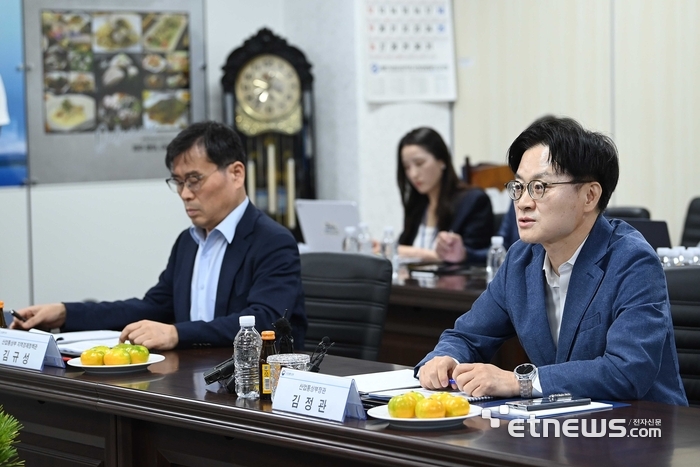
Following the forum, Kim traveled directly to Jeju Island to continue his regional tour tied to the government's “5 Metro Hubs, 3 Special Zones” mega-project. He met with Jeju Governor Wi Seong-gon to discuss plans for cultivating region-specific growth engines, then visited the Jeju Advanced Science and Technology Complex for a meeting with energy innovation firms and companies in advanced sectors including space, bio, and IT.
“Korea's unbalanced growth strategy, centered on a single hub in the greater Seoul area, has hit its limits,” Kim said. “Balanced regional growth is no longer a matter of consideration for the regions--it's a survival strategy for the entire country.”
After wrapping up his official schedule, Kim held an informal “chicken and beer” meetup with young local workers at a nearby pub, pledging full government support so that young people can build their futures without having to leave their hometowns.
