








“We Developed ‘Haber-Bosch 2.0’… Enabling Low-Cost Green Ammonia Production”
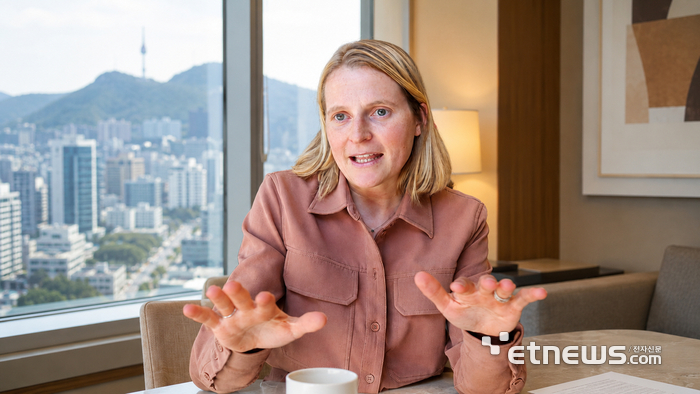
“Hydrogen and ammonia are not competitors. Ammonia is the most efficient 'container' for storing and transporting hydrogen.”
Karen Baert, CEO of Silicon Valley-based green ammonia startup Ammobia, emphasized that “ammonia will become a key solution for South Korea to achieve both energy security and carbon neutrality.”
Baert described ammonia as “the container for hydrogen.” While hydrogen is a clean energy source that produces no carbon emissions, it is difficult to store and transport over long distances. Ammonia, by contrast, can leverage an existing global storage and transportation infrastructure, making it a far more economical option.
“South Korea will need to import a significant portion of the hydrogen it requires in the future,” she said. “The most practical approach is to produce hydrogen overseas, convert it into ammonia for transportation, and then either use the ammonia directly in Korea or convert it back into hydrogen.”
Ammobia has developed a technology that significantly reduces the cost of green ammonia production by reinventing the conventional Haber-Bosch process.
“Today, 99% of the world's ammonia is produced using the century-old Haber-Bosch process, which requires extremely high temperatures and pressures, consumes enormous amounts of energy, and relies on large-scale facilities,” Baert explained. “Ammobia has developed 'Haber-Bosch 2.0,' a technology that produces ammonia at one-tenth the pressure of the conventional process and at much lower temperatures.”
She added that the technology enables modular, distributed production, allowing renewable hydrogen to be converted into ammonia much more cost-effectively.

Baert also spoke highly of South Korea's shipbuilding industry.
“Ammonia will serve not only as an energy commodity to be transported around the world but also as a clean-burning maritime shipping fuel,” she said. “Korean shipbuilders, led by HD Hyundai, are already at the forefront of the ammonia carrier and ammonia-fueled vessel market, and they are well positioned to seize significant growth opportunities over the coming decades.”
She also pointed to the rapid transformation of global energy supply chains.
“In the past, ammonia could only be produced in countries with abundant natural gas or coal. Going forward, however, any country with plentiful wind and solar resources will be able to produce green ammonia. As supply chains become more geographically diversified rather than concentrated in a few regions, energy security will be significantly strengthened.”
Baert noted that South Korea currently imports about 1.3 million tons of ammonia annually, and said imports are expected to increase substantially as ammonia takes on a growing role in providing clean, reliable, and dispatchable power toward 2050.
“South Korea should diversify its sources of ammonia imports while proactively investing in port facilities and storage infrastructure,” she advised.
She also expressed a strong interest in expanding partnerships with Korean companies.
Ammobia has already secured strategic investments from global industry leaders, including Chevron in the United States, Shell and Air Liquide in Europe, and Chiyoda and Mitsui O.S.K. Lines (MOL) in Japan.
“Our next goal is to establish strategic partnerships with Korean companies, and we have active conversations underway,” Baert said.
She added, “South Korea possesses world-class capabilities in hydrogen and ammonia technologies, shipbuilding, and the chemical industry. Combining those strengths with Ammobia's low-cost green ammonia production technology would create tremendous synergies.”
