








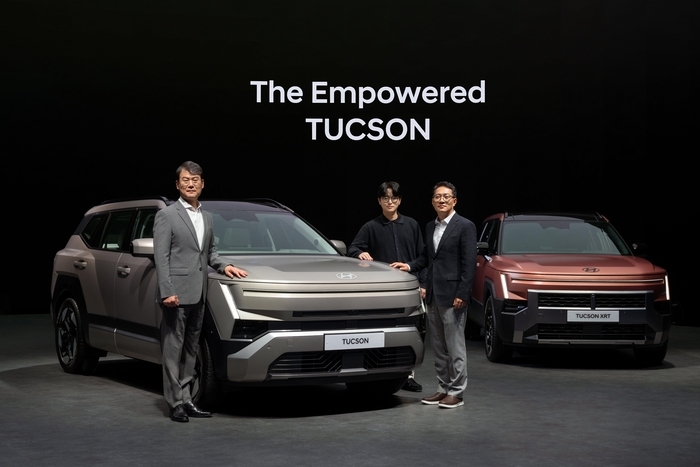
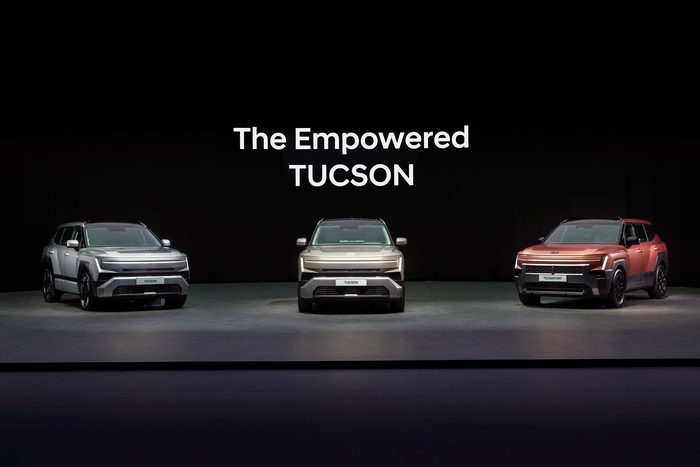
Hyundai Motor has unveiled the fifth-generation Tucson, a full redesign of its global compact SUV bestseller, six years after the fourth-generation model launched in 2020.
The new model, called the All-New Tucson, succeeds a vehicle line that surpassed 10 million cumulative sales worldwide last year. Hyundai presented the SUV at an All-New Tucson Media Day held on Sept. 18 at the CJ ENM Studio Center in Paju, Gyeonggi Province.
Hyundai said the redesigned Tucson brings major upgrades in design, electrification and digital technology.
“The Tucson has become a true global SUV since its debut in 2004, reaching 10 million cumulative sales last year,” Yoon Hyo-jun, head of Hyundai Motor's Domestic Business Division, said. “By combining our strong 'Art of Steel' design philosophy, a next-generation hybrid system and the Gleo AI assistant, we aim to deliver a new level of mobility experience.”
The new Tucson has grown substantially in size to improve its appeal as a family SUV. Its overall length has increased by 60 millimeters to 4,700 mm, while its wheelbase has been extended by 30 mm to 2,785 mm. Second-row headroom has been expanded to 1,031 mm, and the rear doors now open up to 83 degrees to make entry and exit easier.
“The vehicle's fuller surfaces create a solid and confident presence,” said Cho Beom-su, head of Hyundai's Exterior Design Office. “We will also offer an XRT trim with dedicated styling for customers who prefer a more off-road-inspired look.”
The powertrain lineup includes a 1.6-liter turbocharged gasoline engine and a 1.6-liter turbocharged hybrid. The gasoline model produces 193 horsepower and replaces the previous seven-speed dual-clutch transmission with a new eight-speed automatic transmission, which Hyundai says provides smoother driving performance.
The next-generation hybrid delivers a combined maximum output of 245 horsepower and a fuel-economy rating of 17.4 kilometers per liter. It also includes a Stay Mode that allows drivers to use convenience features while parked without idling the engine.
Hyundai has also upgraded the Tucson's safety and digital features. The SUV is the first Hyundai model to adopt a redundant door-unlock power system, which uses backup power to unlock the doors if a collision interrupts the vehicle's primary power supply.
Pedal Misapplication Safety Assist and Parking Collision-Avoidance Assist 2-Front, or PCA-F, are standard across all trims.
The new Tucson is also the first SUV in Hyundai's lineup to feature Pleos Connect, the company's next-generation infotainment system, following its introduction in the new Grandeur and Avante. The system is paired with a 17-inch display.
“We significantly improved ride comfort by reducing road vibrations and secured more spacious interior room,” said Seo Man-gyu, who led the development project. “We focused on strengthening the qualities SUV buyers expect most—durability and safety—from the fundamentals.”
Hyundai plans to begin domestic sales next month before rolling out the new Tucson sequentially in the United States, Europe, Africa and the Middle East. The company has set a domestic annual sales target of 60,000 units. Detailed pricing by trim will be announced when sales begin next month.
Industry observers expect the new Tucson to be priced about 3 million KRW to 4 million KRW higher than the outgoing model. The expected increase reflects higher costs from structural reinforcement and upgraded components, including the new eight-speed automatic transmission, a high-voltage battery-management system and a higher-performance application processor for Pleos Connect.
If Hyundai discontinues lower-priced entry trims, the 1.6-liter gasoline Tucson could start in the low 30 million KRW range, while the hybrid could begin at around 36 million KRW after applicable tax benefits. A fully equipped top trim could approach 47 million KRW, potentially creating price overlap with Hyundai's larger Santa Fe SUV.
