








Hyundai Motor Group has outlined a more concrete timetable for commercializing autonomous driving through a two-track strategy that combines external partnerships with in-house technology development. The group plans to introduce Nvidia-based solutions in production vehicles in 2028, followed by the rollout of its internally developed Atria AI model in 2029.
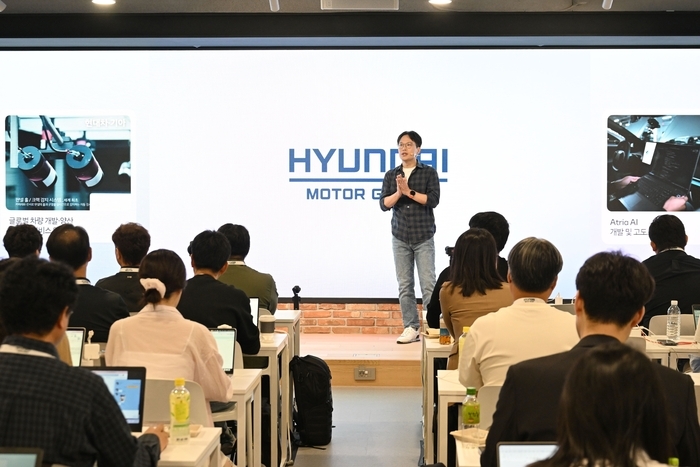
Hyundai Motor Group held its Autonomous Driving Media Day on Sep. 11 at the headquarters of 42dot in Seongnam, Gyeonggi Province, where it presented its technology roadmap, development achievements, and commercialization strategy.
The group plans to integrate Nvidia's automotive AI computing platform and autonomous-driving software into its software-defined vehicle (SDV) architecture. It aims to launch production vehicles with Level 2+ driving-assistance features in the first half of 2028, followed by Level 2++ models in the second half of that year.
At the same time, Hyundai Motor and Kia's Advanced Vehicle Platform (AVP) Division and 42dot are jointly developing an in-house model called Atria AI using an end-to-end (E2E) approach. The group plans to continue advancing the model and begin mass-producing vehicles equipped with its own AI-based Level 2++ system in the second half of 2029.
Hyundai's strategy is to use the Nvidia platform as an early production pathway while applying the engineering know-how and real-world vehicle data gathered from that rollout to improve Atria AI. The company expects this feedback loop to raise the maturity and reliability of its in-house autonomous-driving system before wider commercialization.
The group also presented a hardware roadmap based on Nvidia DRIVE Hyperion 10 specifications. Hyundai plans to progressively standardize its sensor architecture. Production vehicles scheduled for 2028 are expected to include 10 cameras, one forward-facing radar, and 12 ultrasonic sensors as standard equipment.
For the autonomous-driving computer, Hyundai is reviewing Nvidia DRIVE Orin X as a preferred option. The company said the platform is intended to support software updates for at least seven to eight years after vehicle purchase.
Hyundai also highlighted its newly established “data flywheel” system, which it believes could become a strong challenger in the data-driven autonomous-driving market led by Tesla. By combining its global production capacity of more than 7 million vehicles per year with a system for collecting and training on real-world driving data, Hyundai aims to improve its handling of difficult edge cases at a faster pace.
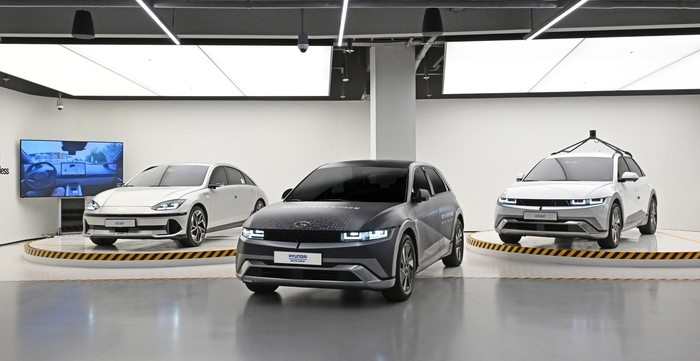
At the event, Hyundai unveiled unedited, one-take urban driving footage of an SDV testbed vehicle equipped with Atria AI. The vehicle was shown driving through Seoul on the Pangyo-to-Gwanghwamun route and in congested Gangnam morning traffic. The footage included responses to 10 edge cases, including unprotected left turns and avoiding vehicles parked or stopped on the road shoulder.
42dot also outlined its longer-term technology plans. The company has begun developing a vision-language-action (VLA) model designed to combine visual perception, language understanding, and action planning for complex-situation reasoning.
Later this year, 42dot plans to work with South Korea's Ministry of Land, Infrastructure and Transport to deploy SDV demonstration vehicles in the Gwangju-Jeonnam Integrated Special City project. The tests are intended to evaluate Level 4 autonomous-driving technology.
“Autonomous-driving competition is ultimately not about which company has a better individual feature, but about who learns faster,” said Park Min-woo, head of Hyundai Motor and Kia's AVP Division and chief executive of 42dot. “We will rapidly develop autonomous-driving technology that customers can trust through a virtuous cycle in which data, AI, and validation continuously reinforce one another.”
