








New Application Fields for Electronic Simulation With Vishay Thermistors
After more than 30 years of SPICE development, many passive components still do not have SPICE models available. Unlike IC vendors, which publish these models to help engineers simulate and design in their chips, most passive component manufacturers - particularly manufacturers of non-linear resistors - do not provide them. Instead, they typically release only static datasheets and generally do not view their products as “design-critical” for simulation purposes.
Because of this, manufacturers assume engineers will use margin-based rather than simulation-based design methods. As a result, engineers often rely on simplified or empirical approaches: designing with derating and safety margins, using measured test data, or modeling the component as a basic switch or thermal delay. In many cases, the non-linear behavior of the passive component is simply omitted from the simulation, with performance verified later using the actual hardware.
Mike Engelhardt, known for LTspice® and QSPICE®, once said in an interview about the LTspice simulator that SPICE simulation is not a way to verify a design because no IC model includes all temperature effects or manufacturing tolerances. However, he noted that SPICE simulation helps designers develop intuition about their circuits, which is invaluable.
This should be food for thought for any supplier of passive and non-linear components. In retrospect, I can say that it has been for Vishay. If we want our published models to be used effectively by designers, they should include thermal effects and manufacturing tolerances. That is exactly what Vishay has done since 2014 for its NTC and PTC thermistors. We have reached a point where we not only supply the models, but also complete application circuits for uses as diverse as fire detectors, LED current mitigation, PWM digital control, and PID control.
As the world of electronic simulation has become increasingly fragmented - spanning digital, analog, PC-based, and cloud-based platforms - Vishay has developed modeling building blocks compatible with nearly all types of simulators.
As a central reference, Vishay document 29235, “Electronic Simulation Toolkit for Vishay Non-Linear Resistors,” provides a comprehensive guide for electronic circuit designers working with Vishay models. It explains how to build a Berkeley NTC SPICE model when one is not readily available (section 6.3), using temperature as an external voltage source. This approach allows designers to build complete, self-contained simulations in which the NTC input temperature is generated by the simulated circuit itself and fed back into the thermistor through an R-C network representing the thermal inertia of the surrounding medium.
The document also outlines the simulation platforms that can be used with Vishay models, including LTspice, SIMetrix, Multisim, PartQuest Explore, and the recently added QSPICE from Qorvo. In addition, it describes how to integrate new or existing models into a wide range of applications, such as Peltier coolers (sections 7.1 and 9.1), on/off temperature control with optotriacs (section 10.2), PWM or PID temperature control systems based on optotriacs or optocouplers (sections 7 and 10.1), temperature compensation circuits for strain gauges (sections 3.2 and 6.2), thermostats (section 7.2), inverter applications with thermal effects (section 5), and LED current mitigation (sections 6.1 and 12). Across these application simulations, the document demonstrates that NTC models using voltage as a temperature input are flexible enough to be integrated into virtually any application.
Further sections explain how to define networks of PTC inrush current limiters (sections 4.1 and 4.2) in precharge circuits for automotive applications with variable ambient temperatures, including derating considerations and calculations that are tedious to perform manually. Finally, section 14 addresses overvoltage circuit protection using VDRs and MLVs.
In parallel with this expanding simulation toolkit, Vishay also offers a series of videos dedicated to electronic simulation with thermistors and RTDs. The “Vishay Thermistors Electronic Simulation” series features three webinars. The first presents live applications based on simulations included in the simulation toolkit; the second focuses on QSPICE, which is discussed further in this article; and the third is dedicated to SIMULINK-SIMSCAPE. Developed by MathWorks, SIMSCAPE is a multidomain platform that enables physical system simulation within the SIMULINK environment. Because NTC thermistors are external, temperature-sensitive resistors that may be subject to self-heating, SIMSCAPE provides an ideal framework for integrating Vishay thermistor models into its libraries. One of the foundational steps in this integration is demonstrated in the MATLAB Central File Exchange example “Thermistors (NTC and RTD) from Vishay Modeled in SIMSCAPE.”
Recent developments in thermistor simulation have focused on two key areas: inrush current limitation and digital temperature simulation. Following Ametherm, a specialist in NTC inrush current limiting thermistors, joining Vishay, the company expanded its capabilities in power and analog electronics. NTC inrush current limiters are now used in applications as diverse as motor drives, welding equipment, charging equipment, circuit breakers, industrial automation systems, and airport control systems. An example of how these designs can be simulated is provided in Vishay application note 24291, which covers the SPICE modeling of Ametherm inrush current limiters using QSPICE from Qorvo.
Turning to the significant shift toward digital electronics, QSPICE is a powerful asset. In addition to being free to use, it allows designers to integrate numerous Verilog or C++ modules alongside analog components such as sensors, reference resistors, and control devices. Vishay application note 29237 demonstrates this capability by explaining how Verilog modules can be integrated to achieve optimized temperature control.
As a final area of innovation, Vishay has launched additional protection devices to complement its ceramic PTC range, including polymeric PTCs (PPTCs), also known as Polyfuse® resettable fuses. Accurate PPTC models remain scarce in the market, largely because potential product models are complicated by the simultaneous presence of wide tolerances and hysteresis effects. Furthermore, most manufacturers provide limited data on the thermal properties of these devices. For example, the Bel Power 0ZAF Series datasheet includes only a graph (Figure 1) showing the device's response time, or “time to trip,” under fault current conditions.
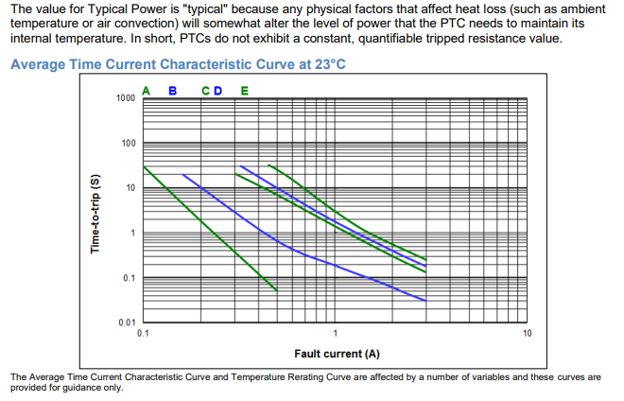
Vishay has successfully developed a SPICE model capable of accurately reproducing the characteristic curves shown in Figure 1 within a practical margin of approximation. The model not only captures both switching and non-switching current behavior, but also allows users to define adjustable tolerances, which are typically ±50% for resistance at low temperatures (around 23 °C). To account for the hysteresis observed after switching, the upper tolerance can be extended, for example, to +60%. A simplified schematic of the model is shown in Figure 2.
The PPTC thermal model is represented as a three-stage Cauer network. The TPPTC node represents the temperature of the internal active polymer PTC material, while the Telectrode node corresponds to the temperature at the component electrodes. TPCB represents the temperature at the PCB solder joint level, and Tambient denotes the far-field ambient temperature. The three Rth/Cth pairs model the thermal resistances and thermal capacitances between, or associated with, these four nodes.
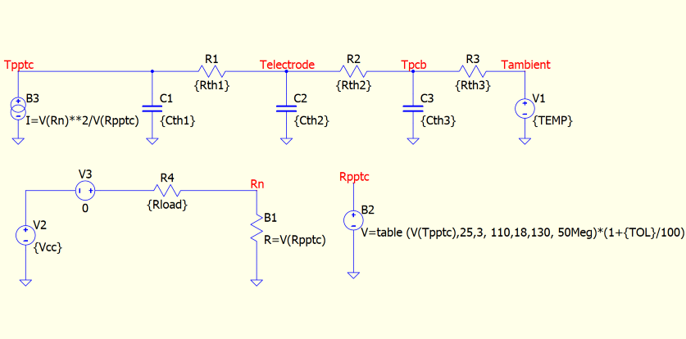
In Figure 2, I(V3) represents the datasheet fault current. TEMP is the ambient temperature, which, when swept, shows the corresponding derating in I(V3). The relationship between resistance and temperature is represented by behavioral voltage source B2, a parameter often absent from datasheets. The six thermal parameters (Rth1, Cth1, Rth2, Cth2, Rth3, and Cth3) can then be adjusted to align the simulation results with the datasheet trip time. Once complete, sweeping the TOL parameter, applied to Rpptc, provides the limit curves.
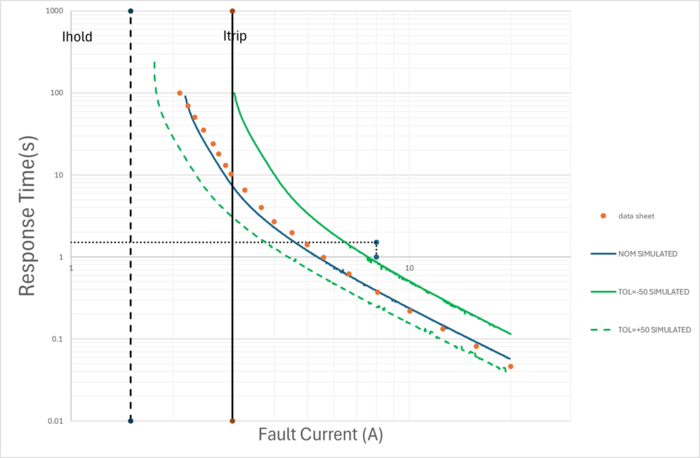
While sweeping six parameters is not typically possible in SPICE programs, QSPICE supports this capability, making it well suited to building efficient behavioral models. The initial optimization results, shown in Figure 3, demonstrate a strong correlation with the datasheet values.
The SPICE-ification of passive components such as PTC and NTC thermistors will be a long process. However, with continued efforts from manufacturers such as Vishay and growing demand from the engineering community, this process is steadily advancing. In the future, it may become a seamless part of component delivery.
By Alain Stas, Vishay Intertechnology
