








LG Electronics will open its Yangjae Data Factory in Seoul, built for in-house robot artificial intelligence (AI) development, to industry, academia, and research institutions. The facility is expected to be widely utilized not only for LG's own robot learning but also for domestic companies' development and verification of robot foundation models (RFM), leveraging LG's robot development infrastructure.
LG Electronics will operate the data factory, set for completion within the year, as an “open robot AI data factory.” It will collect behavioral data from various humanoid robots developed by domestic companies and link part of the facility with external industry-academia-research entities, such as the M.AX Manufacturing Alliance, to enable shared use. This move aligns with a government-funded national project, opening LG's proprietary robot capabilities to external partners.
The Yangjae Data Factory spans 10,000 square meters and is under construction as a robot AI training facility. LG plans to deploy hundreds of robots by year-end to accumulate 100,000 hours of training data—equivalent to approximately 12 years' worth.
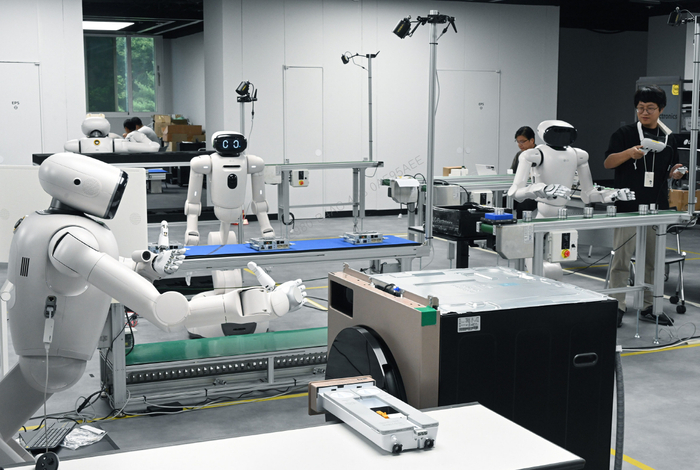
The Data Factory focuses on expanding large-scale robot data collection and learning capabilities to domestic industrial sites. It will replicate work environments across key domestic industries such as logistics, electronics, pharmaceuticals, food, textiles, automotive, batteries, shipbuilding, and chemicals, and secure data centered on six common processes performed by robots.
The primary targets are expected to be universal process technologies, including tasks where robots move or stack boxes, perform defect inspections using cameras, handle packaging, conduct bin picking (moving parts from a bin), and perform kitting (gathering components needed for assembly).
LG Electronics is also likely to utilize advanced virtual environment-based robot learning technologies developed in collaboration with NVIDIA. LG is building a system that uses NVIDIA's Omniverse, Cosmos, and Isaac physical AI technologies to amplify and synthesize real-world task data in virtual environments and apply it back to robot learning. Through this, they aim to develop technologies that allow humanoids with different structures to share motion data and apply tasks learned in virtual environments to real robots.
As early as this year, a consortium of at least two domestic RFM (Robotics Framework Model) development companies is expected to participate in a testbed to apply and verify RFM models on LG Data Factory robots.
An industry official expressed optimism, stating, “Open data sharing will promote joint utilization by universities, research institutions, and companies, contributing to robot AI technology development, reducing demonstration costs, and expanding new services and startups.”
