








Hyundai Motor Company will aggressively target the market by maintaining its global sales target of 5.55 million units by 2030, launching more than 100 new models, and expanding production capacity by 1.27 million units despite external economic uncertainties. It is raising its 2030 operating profit margin target to over 9%, while significantly strengthening shareholder returns by fully canceling treasury stocks worth KRW800 billion.
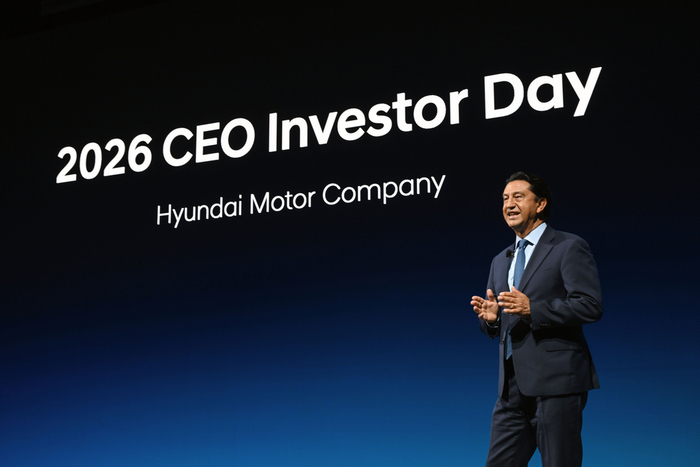
Hyundai Motor held '2026 CEO Investor Day' at the Conrad Hotel in Yeouido, Seoul, on the 26th and announced such mid-to-long-term business strategies and financial plans.
Hyundai Motor reaffirmed its sales target of 5.55 million units (electrified vehicle proportion of 60%) by 2030 despite geopolitical risks and an electric vehicle chasm (temporary slowdown in demand). To this end, it will release more than 100 new models, including 18 new vehicle classes, to the global market by 2030, and expand global production capacity by 1.27 million units, including North America (500,000 units), India (320,000 units), and domestic (200,000 units).
By region, in North America, it will raise the HEV proportion to 50% by launching 10 new hybrid (HEV) models and introducing the Santa Fe EREV (Extended-Range Electric Vehicle). In Europe, starting with the 'IONIQ 3' to be launched next month, it will expand electric vehicle (EV) sales to 420,000 units by 2030. Genesis also plans to achieve global sales of 350,000 units, led by the flagship EV 'GV90', GV80 HEV, and EREV capable of driving more than 1,000 km.
It will also strengthen future mobility and 'Physical Artificial Intelligence (AI)' capabilities. In collaboration with Nvidia, it will apply autonomous driving Level 2+ to mass-production Software-Defined Vehicle (SDV) models in 2028, and operate a 100 MW AI data center in Saemangeum in 2029. From the fourth quarter, it will ship robotaxis for Waymo supply produced at the Georgia Metaplant, and in 2028, it will actually deploy the industrial humanoid robot 'Atlas' on site.
Measures to improve profitability and shareholder value were also materialized. By reducing the cost-to-sales ratio (-3 percentage points), it raised its 2030 operating profit margin target from the existing 8-9% to over 9%. As shareholder return policies, it promised to achieve a Total Shareholder Return (TSR) rate of over 35% and maintain a minimum dividend of KRW10,000, and decided to immediately cancel all existing treasury stocks (about KRW800 billion).
Jose Munoz, president and CEO of Hyundai Motor, stated, “Hyundai Motor's fundamentals are stronger than ever,” adding, “We will launch more models, provide customers with more powertrain options, and aggressively enter new vehicle classes and new markets.”
Munoz continued, “Based on strategic partnerships, we will advance future new technologies, create new opportunities, and reborn as a physical artificial intelligence company that produces and deploys robots and robotaxis.”
