








LG Display is targeting the laptop and monitor market with FLiPP, its photopatterning technology for producing red, green and blue (RGB) OLED displays without a fine metal mask (FMM).
“IT products such as laptops and monitors, where there is customer demand, will be the first applications,” LG Display Chief Technology Officer Choi Young-seok said during an online technology seminar on Oct. 8.
FLiPP is LG Display's name for an OLED manufacturing process that uses photolithography rather than a fine metal mask to form pixels. RGB organic materials are deposited across the entire substrate and covered with a protective encapsulation layer. Ultraviolet (UV) light is then used in the patterning process to precisely remove unwanted areas, leaving the pixels in place.
LG Display plans to introduce FLiPP first in the IT display market, where the shift from liquid crystal displays (LCDs) to OLED is accelerating, rather than in the mature smartphone market, where OLED adoption is already high. It then intends to expand into applications ranging from wearables to extra-large TVs, depending on customer requirements and market readiness.
“In theory, we believe FLiPP can deliver a higher aperture ratio than FMM and potentially reach an ambitious resolution of 1,000 pixels per inch,” Choi said. “But for smartphones, our existing production equipment is performing well, so we plan to continue using FMM for the time being.”
“Our goal is not to enter an already mature market, but to open up the IT market with FLiPP,” he added.
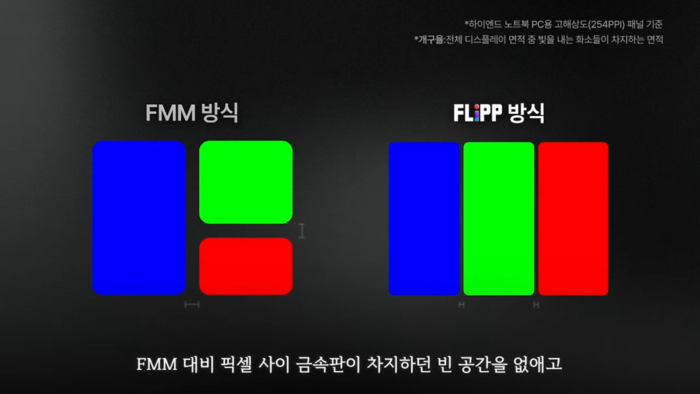
According to LG Display, FLiPP eliminates the gaps between pixels required by the FMM process, increasing the display's aperture ratio—the proportion of its area that emits light—from 42% to 65%, an improvement of about 55%. Compared with conventional FMM-based OLEDs, the technology can deliver 1.6 times the brightness, 2.4 times the lifespan or a 13% reduction in power consumption. The company said independently controlling the red, green and blue elements also enables a wide color gamut and wide viewing angles.
The process also offers manufacturing advantages. While the FMM method uses a half-cut process in which large glass substrates are cut in half before deposition, FLiPP allows continuous in-line deposition on full-size Generation 8.5 glass substrates.
LG Display said this increased the proportion of each substrate usable for 23.5-inch panels from 75% to 93%. Organic material utilization rose from 40% to 74%, a roughly 1.9-fold improvement, while deposition time fell by about 40%.
Using full-size Generation 8.5 substrates also allows a single manufacturing platform to support applications ranging from 1-inch smartwatch displays to TVs larger than 100 inches, as well as augmented and virtual reality devices.
“FLiPP represents the most advanced process innovation currently available for eighth-generation display manufacturing and will serve as a competitive moat that other display makers will find daunting to challenge,” Choi said. “It will mark a turning point that changes the paradigm of the global display industry.”
