





Active Adoption of 1000 RT-Class Systems,
Test Standards Stagnant at 600 RT
“Urgent Need for Market-Reflective Certification System”
While the government is promoting the expansion of heat pump adoption as a core technology for the Green Transition (K-GX), domestic testing and certification systems to support industrial-scale large-capacity equipment remain inadequate.
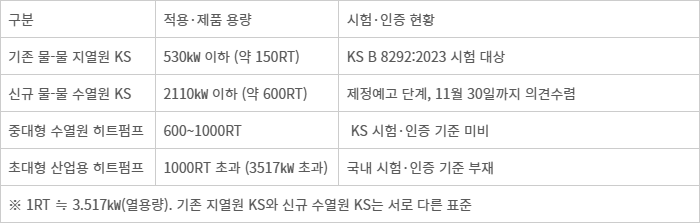
Current national standards (KS) for heat pumps only cover systems up to 150 refrigeration tons (RT), with new standards also limited to a maximum of 600 RT. This creates a significant gap with actual industrial sites where systems exceeding 1000 RT are being introduced.
Delays in establishing fundamental industrial infrastructure, such as testing and certification, could hinder the government's vision of linking K-GX to new growth industries and export drivers.
The National Agency for Technology and Standards has announced a draft KS for water-to-water heat pumps using water heat sources and is collecting public opinions until the end of next month. This follows the government's policy to expand the adoption of water energy using river water, despite the lack of performance evaluation methods or standards for such products.

The issue is that even the newly proposed testing standards fail to adequately cover large-capacity industrial sites. The draft regulation only designates products with a rated cooling/heating capacity of 2,110 kW (approximately 600 RT) or less as testing subjects. Products exceeding this capacity are not included in the performance testing scope under the standard.
This is because a prior study conducted four years ago did not sufficiently secure and verify data for products exceeding 600 RT. Although the standard commentary presents the 600-1,000 RT range as a typical product capacity range, there is still no clear KS testing/certification system that comprehensively covers it. This applies not only to water-source heat pumps but also to air-to-water heat pumps, for which testing/certification systems for industrial large-capacity products remain unestablished.
However, unlike four years ago when the prior study was conducted, the capacity of water-source heat pumps currently used in industrial settings has far surpassed this threshold. Last year, the Korea Trade Center introduced the first 1,000 RT-class large-capacity water-source heat pump in the country. Industries such as the paper manufacturing sector have also begun deploying heat pumps exceeding 1,000 RT.
Testing and certification standards for facilities exceeding 1,000 RT are entirely absent. Large-capacity facilities surpassing 1,000 RT even fall outside the typical product capacity range outlined in the standard commentary.
An industry official noted, “There are no clear domestic standards for large-capacity products exceeding 1,000 RT. Currently, most large-scale facilities are supplied through customization based on customer requests, so there are no immediate business issues. However, as the market expands in the future, relevant standards will be necessary.”

Expanding large-capacity heat pumps is directly linked to power infrastructure. Installing a 1,000 RT-class large-capacity heat pump may require additional power facilities. It is necessary to re-examine the contracted power and receiving facilities of existing sites. Without unified testing and certification standards for large-capacity products, as is currently the case, it becomes difficult for demand-side users to compare and verify power consumption and efficiency under the same conditions.
An industry official stated, “Testing and certification standards for large-capacity heat pumps must be established as soon as possible to objectively compare power consumption, efficiency, and maximum load during the procurement phase and to reasonably calculate the scale of power expansion.” The official added, “In line with national policy demonstrations, public procurement, and the expansion of large-scale private projects, common standards that allow comparison of different product performances should be prepared urgently.”