






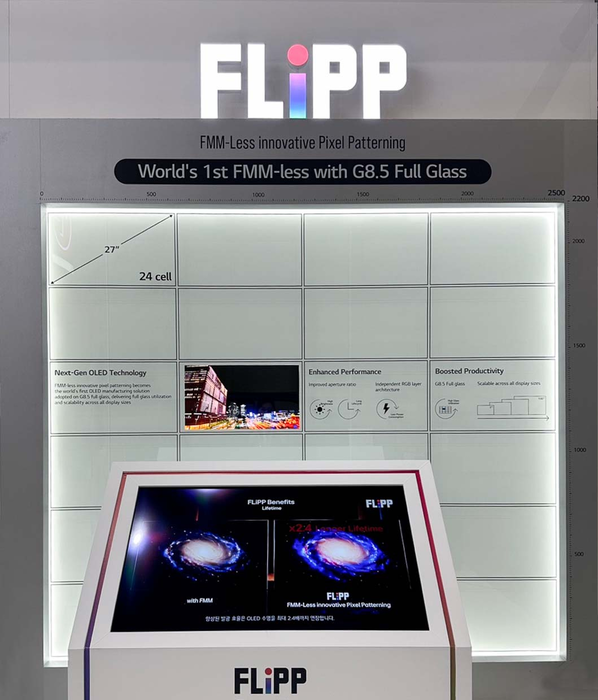
LG Display is reportedly gearing up for an internal review this month regarding 'Flip,' its proprietary red, green, and blue (RGB) OLED manufacturing technology that eliminates the need for a fine metal mask (FMM). Industry watchers are closely watching whether this review will finalize the finer technical details and bring the company a step closer to establishing dedicated production lines.
According to industry sources on Sep. 6, LG Display will conduct an internal briefing on the Flip technology this month.
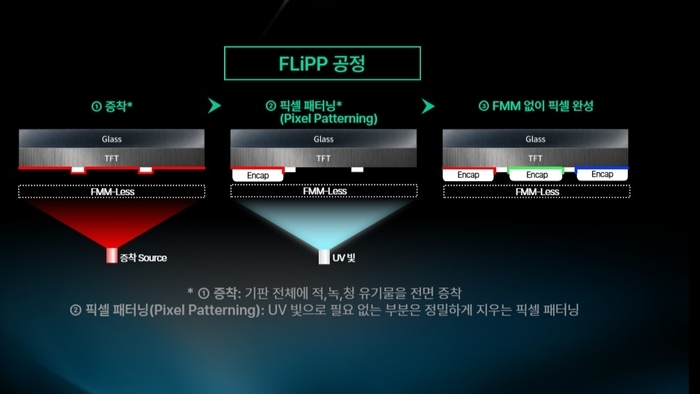
Flip is a non-FMM RGB OLED manufacturing process that LG Display first unveiled last month at the International Meeting on Information Display (IMID 2026) in Busan. The core of this technology involves uniformly depositing OLED emitting materials across the entire substrate and then using ultraviolet (UV) light and photolithography to pattern the pixels by removing unwanted areas.
“LG Display recently showcased a prototype, but it is still in the process of narrowing down specific application techniques, equipment types, and specifications,” multiple industry insiders noted. “We expect this internal review to crystallize the chosen technologies, equipment, and overall scale of the conversion.”
Prevailing industry consensus suggests that once LG Display finalizes these technical parameters, it could begin securing Flip-related equipment as early as the second or third quarter of next year. Analysts point out that even when maximizing existing infrastructure, transitioning to the Flip method requires introducing new materials and processes tailored to the technique, necessitating a dedicated preparation phase.
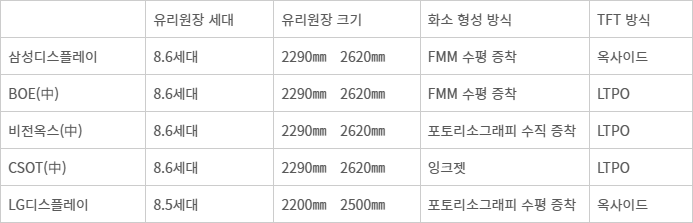
Reports indicate that LG Display plans to repurpose idle 8.5-generation large-format white (W) OLED lines at its Paju plant for exclusive Flip production. Rather than making a heavy capital investment in new 8.6-generation FMM RGB OLED lines, the company aims to secure an 8th-generation RGB OLED manufacturing footprint by efficiently leveraging legacy WOLED assets.
This strategy offers clear advantages, significantly reducing capital expenditure compared to greenfield investments and accelerating the overall timeline.
The ultimate wild card remains manufacturing yield. While overseas rivals like Japan's JDI and China's Visionox have previously pursued photolithography-based RGB OLEDs, mass-production viability has yet to be fully proven. Because LG Display is blazing a new trail with this technology, overcoming the hurdles to secure both high product quality and stable yields is expected to be exceptionally challenging.
Meanwhile, Samsung Display and China's BOE have already built 8.6-generation FMM OLED lines. Visionox is building an 8.6-generation OLED line utilizing a photolithography approach similar to LG Display, but with a vertical deposition method. Meanwhile, CSOT is pursuing investments in an 8.6-generation line that implements OLED pixels via an inkjet printing method, differentiating itself from its competitors.