

SK hynix has begun discussions with its supply chain partners on the application and production of iHBM, a next-generation technology designed to reduce heat generation in high-bandwidth memory (HBM). The move is a strategic effort to stay ahead of intensifying competition in the HBM market and maintain its leadership in artificial intelligence (AI) memory.
According to industry sources on Oct. 21, SK hynix recently contacted domestic and overseas materials, parts and equipment suppliers to advance iHBM technology and prepare for production. The discussions reportedly covered the application of iHBM, which can minimize heat generation in HBM, to actual products and plans for mass production.
“SK hynix is exploring cooperation with materials, parts and equipment suppliers to apply iHBM to actual manufacturing processes and commercialize the technology,” said an official at an SK hynix supplier familiar with the matter. “The company appears to have begun commercialization efforts while assessing the feasibility of mass production.”
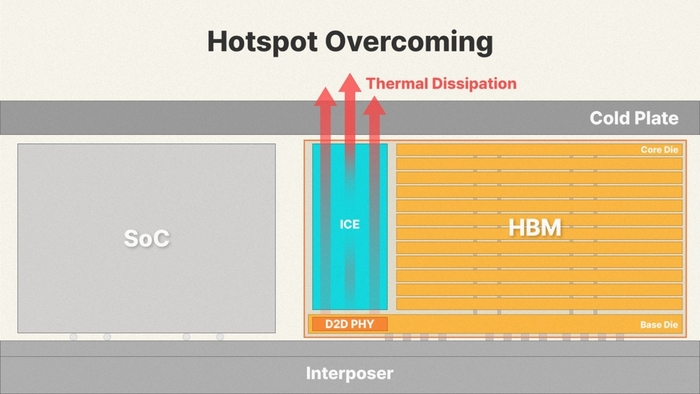
iHBM is a technology unveiled by SK hynix in May. Its key feature is the application of Integrated Cooling Elements (ICE), an integrated cooling component, on top of the base die at the bottom of an HBM stack.
Heat generation is one of the biggest technical challenges facing HBM. In current HBM designs, the base die is in direct contact with the stacked DRAM core dies. The base die contains a physical connection interface, known as the die-to-die (D2D) PHY, that enables ultra-high-speed data communication with graphics processing units (GPUs). As the volume of data processing and the number of stacked HBM layers increase, heat generation becomes more severe. Because this heat is dissipated through the core dies, thermal management efficiency is reduced.
This is one of the biggest obstacles to improving AI infrastructure performance. Failure to control heat can significantly reduce power efficiency. It can also cause performance degradation, system errors and shorter product lifespans. This is why HBM manufacturers are focusing on thermal management.
iHBM incorporates thermal management components, or ICE, into the communication interface area of the base die, creating a new path for heat dissipation. SK hynix explained that this approach can reduce thermal resistance by more than 30%. This means HBM can operate reliably even under high-temperature and high-load conditions, improving the efficiency of AI infrastructure.
iHBM uses a wafer-level packaging (WLP) process based on advanced molded underfill (MR-MUF) technology, which SK hynix has already adopted. The proprietary process stacks HBM chips and fills the gaps between them in a single step. Accordingly, iHBM is expected to use a materials, parts and equipment supply chain similar to that of existing HBM products. SK hynix is also reportedly considering expanding its supplier base alongside its existing supply chain to improve iHBM performance and production efficiency.
SK hynix aims to introduce iHBM technology starting with HBM5. According to the company's HBM5 roadmap, the technology is expected to be introduced in 2029. SK hynix is currently validating HBM5 using CoWoS, Taiwan Semiconductor Manufacturing Co.'s (TSMC) advanced packaging technology.
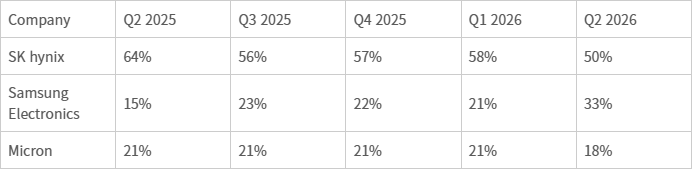
“With competitors rapidly closing the gap by advancing their HBM technologies and expanding production capacity, SK hynix is pursuing technological differentiation to maintain its competitive advantage in the next-generation market,” an industry official said.