








Samsung Electronics is stepping up efforts to expand its presence in artificial intelligence (AI) infrastructure with high-bandwidth memory (HBM), Compute Express Link (CXL) and next-generation solid-state drives (SSDs). The company aims to increase memory speed and capacity, improve data storage and management efficiency, and expand joint system design with global partners.
Samsung Electronics unveiled its next-generation memory and storage technology strategy and the results of collaborations with global partners at the OCP Global Summit 2026, which opened in San Jose, California, on Oct. 12 (local time).
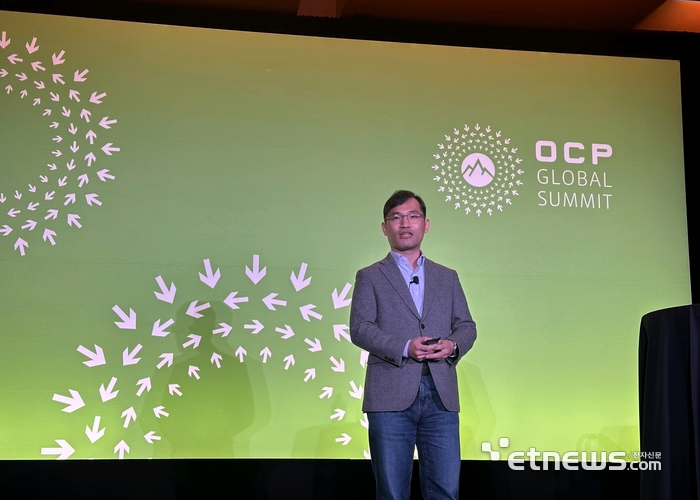
Ho-jun Shim, an executive director on Samsung Electronics' Advanced Engineering (AE) team, identified three technological priorities for improving AI infrastructure performance during a presentation on the opening day: speed, memory scalability and data persistence. Shim explained that as AI models grow larger and key-value (KV) caches, which store data and intermediate computation information during inference, increase, memory capacity and storage and management efficiency are becoming as important as memory bandwidth.
Samsung Electronics plans to improve data processing speeds and computational efficiency through HBM5, customized HBM and processing-in-memory (PIM) technology, which performs some computations within memory. The company also aims to expand memory capacity with CMM-D, a CXL-based memory module, and improve the efficiency of storing and managing large volumes of AI data through next-generation SSDs and high-capacity quad-level cell (QLC) technology.
At the event, Samsung Electronics is jointly demonstrating a CXL-based memory expansion solution with AMD. Using CMM-D-based memory pooling technology, the companies are showcasing ways for multiple systems to efficiently share memory resources and flexibly secure the memory capacity required for AI inference.
Samsung Electronics is also introducing a collaborative framework for jointly designing AI systems with customers from the early stages of development. Samsung MAX Lab is a collaborative environment that evaluates memory and storage technologies under real-world AI workloads and supports joint design tailored to customers' system requirements.
Samsung Electronics is also participating in open-source software development and standardization activities through its Global Open Ecosystem Team (GOST). At the event, the company is showcasing storage software technologies that improve data processing efficiency, including KV cache optimization and direct storage.
Alongside improving the performance of individual memory products, Samsung Electronics plans to pursue system-level optimization encompassing CPUs, GPUs, memory and storage, while expanding joint design and technology validation with global customers and partners.
The OCP Global Summit brings together global IT, semiconductor, server and data center companies to discuss open hardware technologies, standardization and innovation in AI infrastructure. Samsung Electronics is participating as a Diamond sponsor, the event's highest sponsorship tier, for the second consecutive year.
