

LG Display is in talks with South Korean OLED equipment makers YAS and Sunic system over deposition equipment for its next-generation FLiPP OLED process, setting up a potential supplier competition for the planned production line.
YAS had been widely viewed as the front-runner because it previously supplied deposition equipment for LG Display's large-area OLED lines. However, Sunic system has recently emerged as a serious contender, reshaping the selection process into a two-way race, according to industry sources.
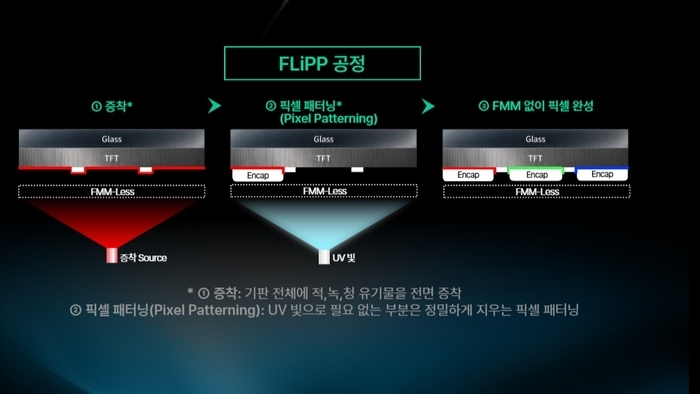
LG Display has begun discussions with Sunic system, in addition to YAS, over deposition equipment for FLiPP OLEDs. FLiPP, short for FMM-less innovative Pixel Patterning, is LG Display's proprietary RGB OLED manufacturing process that replaces the conventional fine metal mask, or FMM, with photolithography.
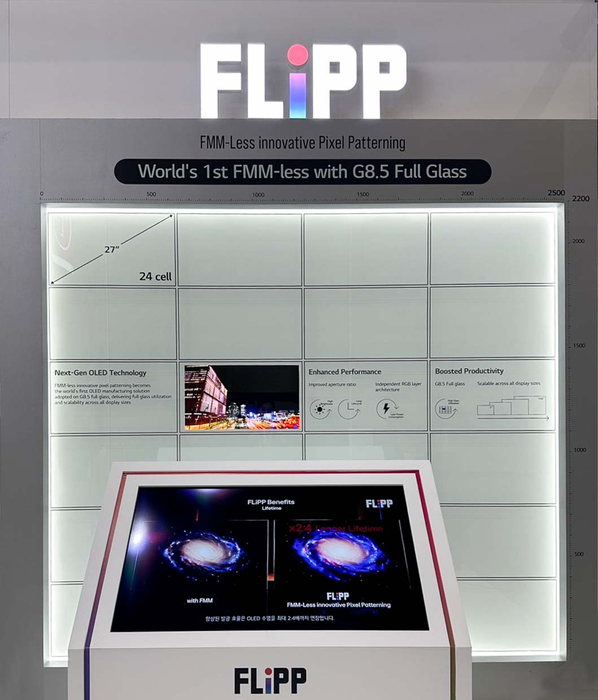
Conventional FMM OLED manufacturing forms red, green and blue subpixels by depositing organic materials through highly precise openings in a metal mask. FLiPP instead deposits organic materials across the full substrate, then uses ultraviolet-light photolithography to remove unwanted material and define the RGB pixel pattern. LG Display unveiled the process in August, describing it as the first mask-free OLED pixel-patterning technology capable of processing a full Generation 8.5 substrate without dividing the mother glass.
The company plans to install dedicated FLiPP equipment on P8, its existing Generation 8.5 large-area OLED production line in Paju. The line is expected to use an in-line, horizontal deposition system.
Unlike FMM deposition systems, which must place RGB materials at highly precise pixel locations, the FLiPP process requires an open-mask deposition tool that coats organic layers across the entire substrate. In that respect, it resembles the deposition step used in LG Display's white OLED, or WOLED, process for large OLED panels.
That similarity had made YAS the leading candidate. The company previously supplied open-mask deposition tools for LG Display's WOLED manufacturing, and the industry had expected YAS either to modify existing equipment or supply new tools for the FLiPP line.
LG Display's discussions with Sunic system, however, have turned the procurement process into a competitive bid. Industry sources said a FLiPP deposition line would require significantly more chambers than a conventional OLED deposition system, raising the possibility that existing tools will need major upgrades or that entirely new equipment will be required.
LG Display is believed to be seeking multiple stable supply options as it pushes FLiPP as a key next-generation technology. Mask-free, photolithography-based OLED manufacturing has proven difficult to commercialize elsewhere: Japan Display and China's Visionox, both early movers in related processes, have faced challenges in scaling them to mass production.
“Concerns surrounding YAS's management control, including issues related to forced sales of pledged shares, have prompted LG Display to consider Sunic system as a strong alternative,” an industry source said. “LG Display is betting heavily on FLiPP OLEDs and is still defining detailed technical specifications, so it will take time before a supplier is selected.”