




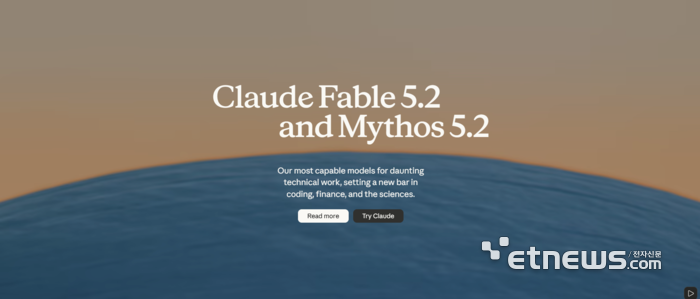
Anthropic has unveiled its next-generation artificial intelligence (AI) models, Claude Fable 5.2 and Claude Mythos 5.2, ahead of its initial public offering (IPO).
The company aims to secure a leading position in the AI market by strengthening software development, robotic control and AI agent collaboration capabilities while advancing its safety verification framework.
Anthropic announced the launch of Fable 5.2 and Mythos 5.2 on Nov. 9 (local time), saying Mythos 5.2 would be made available on a limited basis to select organizations participating in a preliminary testing program.
Fable 5.2 can perform more complex software engineering tasks than previous models and handle hardware-related operations, including robotic control. Its ability to carry out long-term projects has also been enhanced. In particular, the model is designed to coordinate more than 1,000 AI agents simultaneously.
Mythos 5.2 is based on the same underlying model as Fable 5.2 but is a version without certain safety restrictions related to cybersecurity and life sciences.
Anthropic said both models offer faster processing speeds than their predecessors. Fable 5.2 is priced at $8 (approximately KRW10,800) per 1 million input tokens and $40 per 1 million output tokens. These prices represent a 20% reduction from the respective $10 and $50 charged for the previous Fable 5.1 model.
The new models were released as Anthropic prepares for a potential Nasdaq listing as early as this month. The move is seen as an effort to strengthen both model performance and price competitiveness amid intensifying technological competition with rivals such as OpenAI.
However, concerns over AI safety remain a challenge. In September, Dario Amodei, CEO of Anthropic, argued that the pace of development of cutting-edge AI models should be slowed. The Democratic Party's victory in the U.S. midterm elections has also increased the possibility of tighter AI safety regulations.
Anthropic has also emphasized that slowing development is different from stopping it. “Slowing down is not the same as stopping development,” said Diane Penn, head of research product management at Anthropic. The remarks indicate that the company intends to regulate the pace of development by strengthening safety verification rather than unconditionally slowing or halting AI development.
Anthropic applied longer testing periods and new evaluation methods to the models. They underwent preliminary reviews by the U.S. government and external evaluation organizations. The company also developed new metrics to assess the likelihood of AI models escaping isolated digital testing environments known as sandboxes. Its internal evaluations showed that the new models were less likely to escape their sandboxes than previous versions.
Access to Mythos 5.2 is expected to expand beyond the United States to overseas companies. Previously, Mythos was made available on a limited basis to government agencies, financial institutions and major software companies because of its ability to detect and exploit software security vulnerabilities.
Anthropic is reportedly focusing on expanding the use of its high-performance models while ensuring safety and cost efficiency.
