








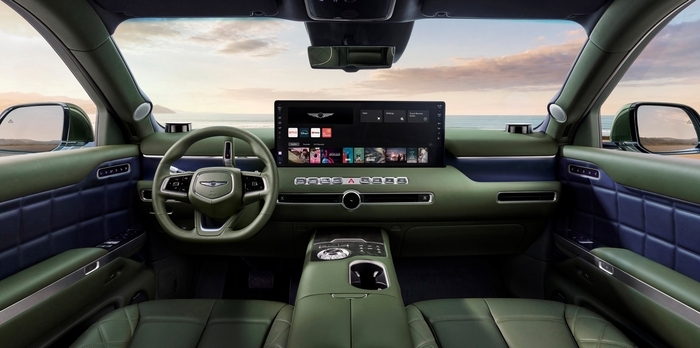
Hyundai Motor Group's Hyundai and Kia have beaten Toyota, Volkswagen, and other global rivals to earn the highest software competitiveness score among legacy automakers in a future-mobility assessment by a global IT research firm.
In Gartner's Digital Automaker Index 2026, Hyundai-Kia scored 37.5% overall and ranked 10th among 24 major global automakers.
That is the highest ranking of any traditional automaker rooted in internal combustion engine vehicles. Hyundai-Kia finished ahead of Mercedes-Benz (11th, 35.8%), BMW (14th, 30.9%), Volkswagen Group (16th, 29.5%), and Stellantis (22nd, 23.0%). Toyota, the world's best-selling automaker, scored in the mid-20% range and ranked below 20th place.
Gartner's Digital Automaker Index is considered a key benchmark for the industry's shift toward software-defined vehicles (SDVs). It rates automakers on their vehicle electrical and electronic (E/E) architecture, connectivity, autonomous driving, artificial intelligence (AI), and over-the-air (OTA) software update capabilities, then combines the results into a single score.
Hyundai-Kia ranked 15th in 2024 and has climbed five places in just two years. At the time, it trailed Mercedes-Benz (11th) and Volkswagen (13th), but it has now overtaken both.
Industry observers say the jump is highly unusual. Legacy automakers typically take four to five years to develop a new vehicle and tend to have rigid, mechanical engineering-driven cultures, so a two-year rise in a software ranking is rare.
Analysts point to two main drivers behind Hyundai-Kia's rise: a sweeping consolidation of its R&D organization under its Advanced Vehicle Platform (AVP) Division, and a practical, execution-focused strategy. That strategy lined up well with a change in Gartner's criteria. Starting this year, Gartner looked beyond whether automakers have a technology and gave heavy weight to how widely it has been deployed across the vehicles they actually sell.
Hyundai-Kia moved early to install its in-house connected car operating system (ccOS) and its new Pleos Connect infotainment platform in high-volume models such as the Grandeur and Avante, known as the Elantra in overseas markets. It has also moved quickly to bring its next-generation zonal architecture, built around four zone controllers, to production vehicles, significantly boosting its deployment score.
The progress contrasts with global rivals that have struggled for years. Volkswagen turned to Rivian for a multitrillion-won (KRW) technology partnership after repeated delays at its in-house software unit, CARIAD. Toyota's plan to fully roll out its Arene operating system has been slowed by internal confusion.
Tesla and Chinese tech and EV companies still dominated the overall rankings. Tesla kept its commanding lead with a score of 82.7%, while Chinese automakers swept second through fifth: Nio (73.1%), Xiaomi (69.2%), XPeng (57.7%), and Li Auto (57.0%). U.S. EV maker Rivian ranked sixth at 55.5%.
