




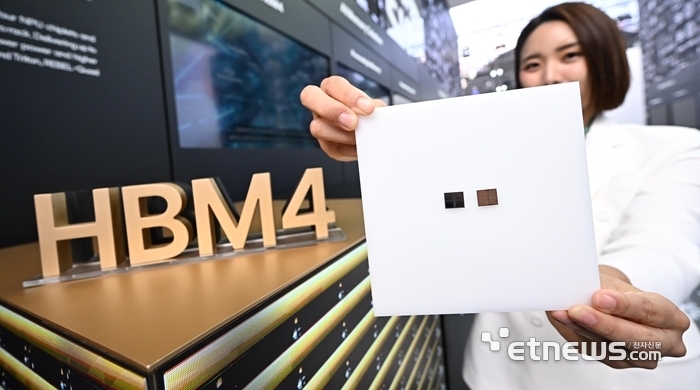
SK Hynix is moving to further expand its production capacity for high-bandwidth memory (HBM4).
Despite growing uncertainty in the artificial intelligence (AI) industry following developments such as Nvidia's CEO transition, the company appears to believe that demand for HBM, a key component of AI infrastructure, remains robust. SK Hynix plans to invest in equipment primarily for HBM packaging and testing, with full-scale operations scheduled to begin in the first half of next year.
According to multiple semiconductor equipment industry officials on Nov. 15, SK Hynix is discussing purchase orders for HBM4 manufacturing equipment with its suppliers. The company is reportedly coordinating procurement schedules and volumes mainly with back-end equipment manufacturers specializing in HBM bonding, cutting and inspection.
“SK Hynix is pursuing additional investment in HBM4 production facilities,” said an SK Hynix supplier familiar with the matter. “The company is accelerating its schedule with the goal of bringing in and installing equipment in the first half of next year.”
SK Hynix is reportedly preparing to move quickly with its facility investments, including requesting delivery of certain equipment by the first quarter.
Cheongju P&T6 is considered the most likely site for the additional production capacity. Formerly known as M8, the semiconductor fabrication plant was designated by SK Hynix as an HBM production base in 2025. The company has been establishing HBM manufacturing lines at the site since early this year. With the additional expansion decision, SK Hynix plans to increase HBM4 production beyond its original schedule.
“The company intends to maximize the use of available space at the P&T6 fab to expand HBM4 production capacity,” another industry official said. “Once the entire fab is fully operational, it could produce additional HBM equivalent to more than 20,000 wafers per month.”
SK Hynix's move is intended to prepare for full-scale demand for HBM4. Although concerns persist that Nvidia's leadership crisis stemming from the so-called “Jensen Huang scandal” could create uncertainty across the AI industry, the prevailing industry view is that semiconductor demand in the AI market remains strong.
Even if Nvidia's AI semiconductor business experiences disruptions, alternative demand from companies such as AMD and Broadcom remains substantial. HBM4 is the latest generation of HBM currently in mass production and supply, and additional manufacturing capacity is reportedly needed to meet industry demand.
During its third-quarter earnings conference call last month, SK Hynix said, “Virtually all of the company's DRAM and high-bandwidth memory (HBM) production volumes for the next three years, through 2029, are already sold out.”
Nvidia's recent decision to lower its target bandwidth, or speed, for HBM4 used in its next-generation AI chip, Vera Rubin, is also a favorable development. By setting a relatively easier-to-achieve speed as the standard, Nvidia has reduced the manufacturing process burden on memory suppliers. The adjustment is believed to have influenced SK Hynix's decision to expand production capacity.
Expectations are also rising in the semiconductor equipment industry. If SK Hynix begins placing purchase orders in earnest, numerous equipment suppliers are expected to benefit.
“SK Hynix is preparing large-scale orders, drawing considerable attention from the industry,” a senior executive at a back-end semiconductor equipment company said. “We expect the benefits of growth in the HBM market to begin spreading throughout the equipment industry.”
In response, an SK Hynix official said, “We have continued placing equipment orders in line with our plans. We intend to respond to market expansion without disruption.”

