








COFA 'Underfill' Quality Evaluation
Mass Production Expected to Start as Early as Within the Year
Market Expansion into HBM Expected
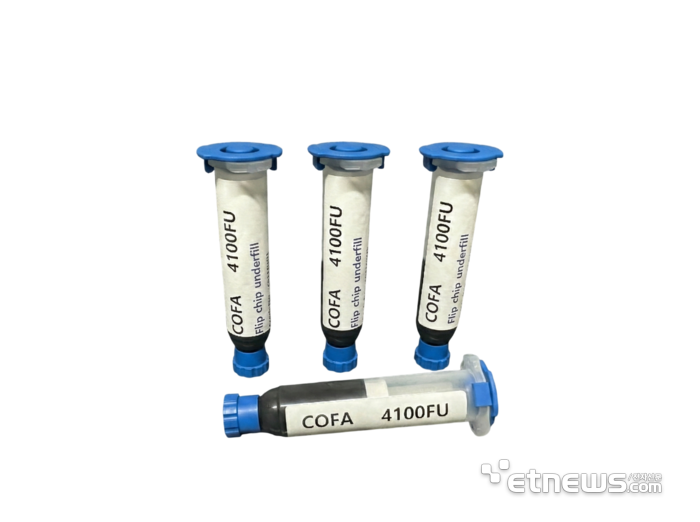
A Korean company has completed preparations to enter the artificial intelligence (AI) semiconductor adhesive material market, which has been monopolized by Japanese and German companies.
Domestic materials startup COFA announced on the 6th that it succeeded in developing underfill, which fills the space between semiconductor chips and substrates, and has entered quality evaluation (qualification) with major packaging companies. Depending on the results of the qual test, the company plans to start initial mass production as early as within the year, and subsequently explore market expansion into underfill for HBM.
Underfill is a liquid resin that fills a space thinner than a human hair (30 to 80 ㎛). Silicon chips and substrates expand and contract at different rates according to temperature changes. When this difference is repeated, stress concentrates on bumps (small metal protrusions for electrical connections between the chip and substrate), which can cause cracks or bonding failures. As chips become larger and generate more heat, like AI accelerators, the importance of this reinforcement increases.
COFA confirmed capillary underfill (CUF) filling and electrical driving in flip-chip (a method of flipping a chip to connect it to a substrate with bumps) packages under conditions of a bump height of 30 ㎛ and a bump pitch (distance between bumps) in the 40 ㎛ range. Using samples developed through this, quality evaluation is underway with multiple packaging companies.
Once the quality evaluation is completed and mass production begins, an achievement in securing a domestic supply chain for underfill will be attained. In the overall electronic adhesives market, Germany and Japan split the pie. In particular, in the flip-chip and HBM underfill fields, products from Japan's NAMICS are used virtually as the standard.
According to Fortune Business Insights, the global electronic adhesives market is growing at 6.8% annually, driven by the expansion of electronic and IT production and the recovery of the semiconductor industry. It is projected to grow from $13.17 billion in 2025 and $13.96 billion in 2026 to $24.08 billion in 2034. As of 2025, the Asia-Pacific region accounts for the highest share at 53.45%.
Among these, the underfill market is a field with high unit prices despite small volumes. Due to demand for advanced packaging, the growth rate is even faster. However, entry by domestic companies has been quite slow. There are no known domestic flip-chip underfills currently adopted and sold to outsourced factories or large semiconductor companies.
If domestic flip-chip underfill materials enter the market, expansion into the HBM underfill field, which has a larger market size, will also become easier.
HBM manufacturers are concerned about relying excessively on the supply chain for Japanese adhesive materials. This is because of the experience during Japan's export restrictions in 2019, when normal business operations were difficult due to the inability to obtain key materials such as photoresists. Currently, SK hynix is known to use NAMICS' underfill, and Samsung Electronics uses Resonac's (film-type NCF) material.
Park Ki-nam, CEO of COFA, said, “As Korea possesses global competitiveness in memory and HBM, a new generation of domestic companies must emerge in packaging materials that support them.” Park added, “Ultimately, the goal is to respond to the 5 ㎛ range, which the global advanced packaging industry has begun to demand.”
