





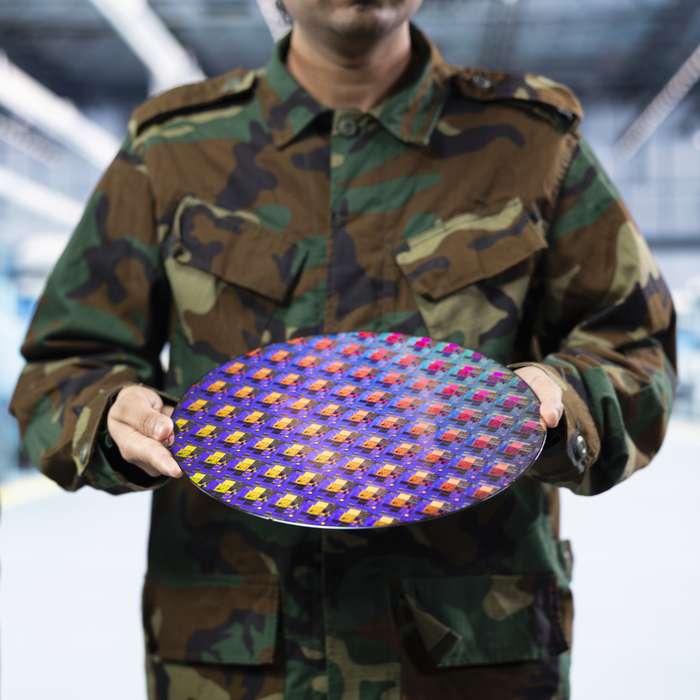
The South Korean government is launching an “investment-type R&D” initiative next year, establishing a special purpose company (SPC) to secure supply chain self-reliance in compound semiconductors—a sector increasingly critical to national defense.
According to government and industry sources on Oct. 18, the Korea Nano Technology Institute and the Compound Semiconductor Technology Association will co-host the “Compound Semiconductor R&D Shared Fab Forum” at the EL Tower in Seoul on Oct. 30. Key stakeholders, including representatives from the Science and Technology Policy Institute (STEPI), the Korea Research Institute for Defense Technology Planning and Advancement (KRIT), and the National Research Foundation of Korea (NRF), will address the strategic value of compound semiconductors, global supply chain vulnerabilities, the SPC roadmap, and the operational role of public nano-fabs.
The forum is designed to lay the groundwork for the Ministry of Science and ICT's (MSIT) upcoming investment-type R&D model. Departing from conventional grant-based programs—which distribute one-way subsidies and yield nominal royalties—this framework involves direct public equity investment in capital-intensive, high-risk sectors where private venture capital rarely ventures alone. Once a project achieves commercial success, the invested capital is recouped and channeled into other strategic domains.
Target sectors slated for next year's rollout include cell and gene therapy commercialization and the shared compound semiconductor fab. Unlike traditional single-element silicon, compound semiconductors are engineered by combining two or more elements—such as gallium nitride (GaN) or silicon carbide (SiC). This molecular composition allows chips to operate stably under extreme voltages and elevated temperatures while delivering significantly higher power output.
These performance advantages have made compound semiconductors indispensable in defense and aerospace applications. Market research firm Mordor Intelligence projects the global compound semiconductor market to expand from $53.7 billion (approx. KRW72.12 trillion or 72.12 trillion KRW) this year to $85.5 billion (approx. KRW114.84 trillion or 114.84 trillion KRW) by 2030, representing a compound annual growth rate of 11.3%.
Despite this rapid global expansion, South Korea's presence and domestic production rates remain critically low. A 2023 survey by the Defense Acquisition Program Administration (DAPA) examined 6,945 semiconductors across 54 key military assets—including radars, precision-guided munitions, and tactical communications systems—and revealed that 98.9% of these critical components were designed or manufactured overseas.
Compounding these vulnerabilities, core raw materials such as gallium and germanium are heavily concentrated in a small number of countries and are increasingly subject to export controls amid escalating tech-security rivalries. The government's joint initiative seeks to build an end-to-end prototyping and testing infrastructure—spanning raw materials, device architecture, and fabrication processes—to establish sovereign defense supply chains.
The ultimate success of the program hinges on private-sector engagement. MSIT has earmarked KRW40 billion or 40 billion KRW for next year's shared fab initiative, which requires matching private capital to establish the SPC. The ministry has already begun assessing investment interest among major domestic semiconductor players.
“This forum will underscore the necessity of equity-driven R&D in compound semiconductors and gather strategic industry feedback required to establish the SPC,” an MSIT official said. “Following the forum, we will issue a formal tender to select private-sector partners.”
