





The fallout from the “Jensen Huang scandal” is affecting Samsung Electronics' foundry business and South Korean outsourced semiconductor assembly and test (OSAT) companies. The U.S. government has sharply restricted the “approved OSAT fast-track” mechanism that semiconductor companies used to quickly process orders from fabless chip designers based in third countries. The move aims to prevent Chinese companies from circumventing restrictions to obtain advanced semiconductors through shell companies established in third countries.
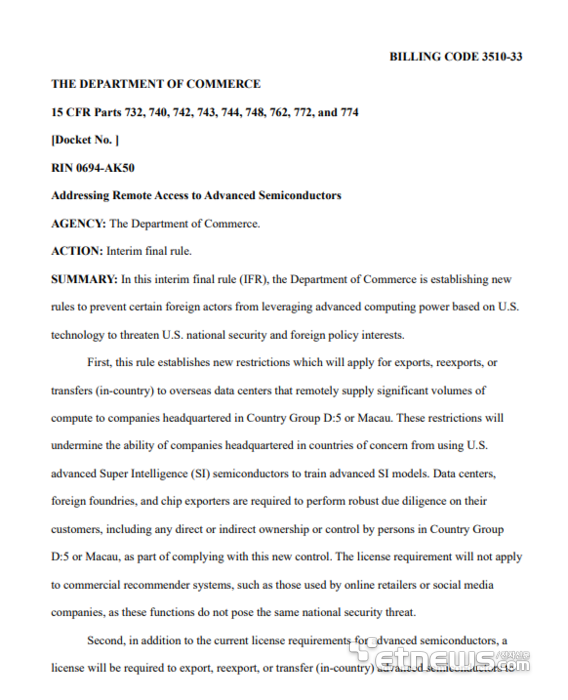
According to the interim final rule (IFR) on advanced semiconductor remote access controls and related measures announced by the U.S. Department of Commerce's Bureau of Industry and Security (BIS) on Nov. 17, the U.S. government has amended the “presumption exemption for advanced computing chips (ECCN 3A090.a)” under the Export Administration Regulations (EAR), tightening exemption requirements for fabless chip designers in certain regions.
Previously, when foundries or back-end semiconductor companies manufactured logic chips using processes of 16 or 14 nanometers (nm) or smaller, the chips were generally presumed to be “advanced AI chips” subject to U.S. export controls, requiring prior export authorization.
However, shipments could proceed without separate U.S. government authorization if the chips were verified through “foundry self-verification (paragraph b)” or packaged by a U.S. government-approved OSAT provider that verified the final chip's transistor count was below the prescribed threshold, generally 30 billion transistors (paragraph c).
The exemption was primarily used by small and medium-sized fabless chip designers that had not obtained the U.S. government's “approved designer” status, which exempts qualifying fabless companies from certain export controls. Six South Korean companies — Samsung Electronics, Doosan Tesna, LB Semicon, Nepes, SFA Semicon and STECO — are among the 24 approved OSAT providers worldwide listed under paragraph (c) of the exemption.
Under the revised rule, the “foundry self-verification (paragraph b)” and “approved OSAT verification (paragraph c)” exemptions will no longer apply if the chip designer or its ultimate parent company is headquartered in countries of concern, including China and Russia, under country groups D:1, D:4 and D:5. The exclusions will also extend to five newly added countries: Singapore, Malaysia, Indonesia, Thailand and Brazil.
The measure is intended to fundamentally block “circumvention manufacturing,” in which Chinese capital establishes front companies in Southeast Asia and splits chip designs to keep transistor counts below the threshold before having AI chips manufactured at foundries in South Korea or Taiwan. This leaves only the “U.S. government-approved and certified designer (paragraph a)” route available.
After the revised rule takes effect on Jan. 1, 2027, fabless chip designers based in the five countries will be required either to obtain approved designer status or secure separate prior export licenses from the U.S. Department of Commerce for individual transactions.
If a company is caught shipping products without authorization in violation of the regulations, it could be placed on the U.S. government's Entity List or face a Denial Order revoking its export privileges. Such sanctions would completely block its access to U.S.-origin equipment, components and software updates.
As a result, South Korea's back-end semiconductor industry and design houses, also known as design solution partners (DSPs), which had sought to attract more overseas orders by leveraging their approved OSAT status, now face a greater burden in verifying customers' ownership structures through know-your-customer (KYC) procedures.
“A significant portion of Samsung's foundry customers and existing customers of South Korean OSAT companies have traditionally been concentrated in North America, while the share of customers from Southeast Asia is still believed to be minimal,” a semiconductor industry official said. “Nevertheless, companies are closely monitoring the situation because the new regulations could negatively affect efforts to secure new customers.”
Meanwhile, the BIS interim final rule also requires prior U.S. government authorization to remotely provide substantial computing capacity, measured by total processing performance (TPP), from U.S.-origin advanced semiconductors and servers to companies headquartered in countries considered national security concerns by the United States, including China, under country group D:5 and Macau.
The measure is a stringent regulatory step intended to fundamentally block Chinese companies from circumventing restrictions through remote access to cloud computing services.
The Chinese government immediately protested the U.S. measures and warned of countermeasures.
“The United States continues to expand the concept of national security and abuse export control measures,” Chinese Foreign Ministry spokesperson Guo Jiakun said at a regular briefing. “It even interferes unjustifiably with normal trade and scientific and technological cooperation between China and other countries, while unfairly suppressing the development of China's high-tech industries.”
“This is typical economic coercion and long-arm jurisdiction, extending the application of domestic laws beyond national borders. It violates the agreements reached between the two countries, undermines the legitimate rights and interests of Chinese companies, and disrupts the stability of global industrial and supply chains,” Guo said.
“China will take necessary measures to firmly safeguard its legitimate rights and interests,” he added.
