



Hyundai Mobis has formed the 'K-Vehicle Semiconductor One Team' with automakers, parts suppliers, semiconductor companies, and research institutions to establish a full-cycle collaboration system for domesticating vehicle semiconductors. Beyond simple design collaboration, the initiative aims to build an ecosystem encompassing software (SW), design assets (IP), packaging, and testing/evaluation, ultimately achieving national-level autonomy in mobility supply chains.
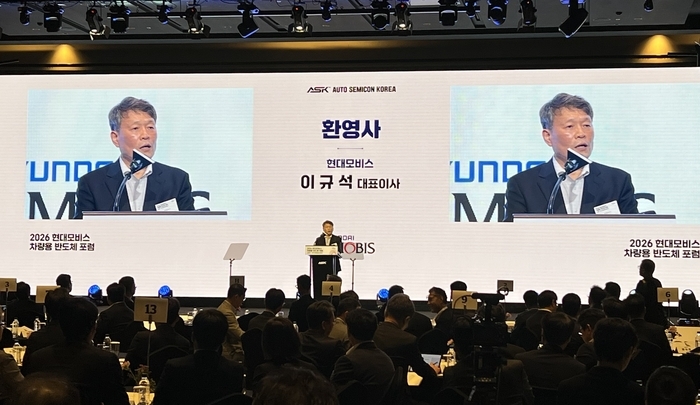
Hyundai Mobis held the 2nd Automotive Semiconductor Forum 'Auto Semicon Korea (ASK)' on the 21st at the DoubleTree by Hilton Seoul Pangyo in Seongnam, Gyeonggi Province. ASK is a collaborative platform launched last year by Hyundai Mobis to strengthen supply chain competitiveness by connecting automotive and semiconductor industries.
At the forum, the 'Vehicle Semiconductor One Team TF,' led by the Ministry of Trade, Industry and Energy, Hyundai Motor, Hyundai Mobis, and LG Electronics, held a launch ceremony to formalize a system for domestic production that links cooperation between demand-supply companies, institutional improvements, and government support. The TF, under the M.AX Alliance division, includes 24 companies and institutions.
The TF plans to organically link cooperation between demand-supply companies, institutional improvements, and government policy support to lay the foundation for national semiconductor self-reliance.
Minister Jeong-han Kim of the Ministry of Trade, Industry and Energy stated, “Vehicle semiconductors are the core brain of future mobility represented by SDVs and electrification, and a critical battleground for supply chain hegemony. The government will spare no policy support, including large-scale R&D and expansion of verification infrastructure, to help the public and private sectors unite as one team and build a self-sustaining full-cycle ecosystem.”
Hyundai Mobis plans to establish a 'demand-driven development system' to proactively respond to future mobility needs. This approach involves first defining semiconductor specifications required for controller structures in line with the transition to software-defined vehicles (SDVs) and electrification, then co-developing them with domestic industries.
Hyundai Mobis is also collaborating with the government to advance the 'Cheonan Vehicle Semiconductor Support Center,' which will provide reliability verification and evaluation support, with a goal to complete it by 2027. The company plans to continue comprehensive support by linking identified projects to government R&D tasks.
