









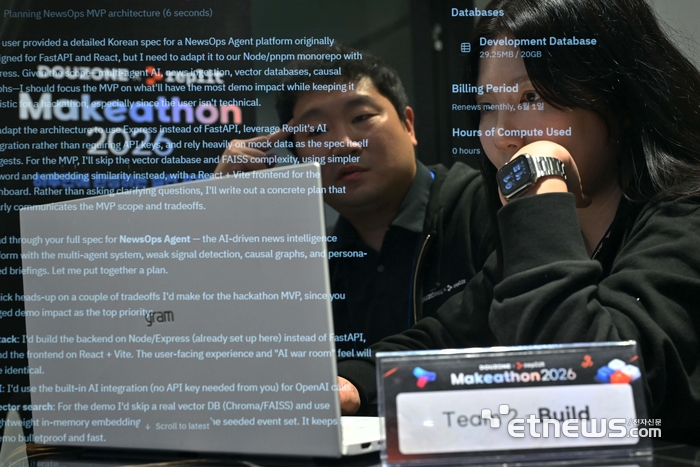
“Create an agent service that analyzes news according to keywords I set and assists in decision-making. Implement real-time news collection and AI briefing functions, and apply a multi-agent system for reporters, corporations, and investors. For the design, base it on an AI war room style and configure it as a high-information-density responsive dashboard.”
As soon as natural language commands were entered into the chat window, the framework of the 'NewsOps Agent' was captured in an instant. After just four hours of continuous conversation and feedback, a functional AI-based news curation platform was completed. This result was achieved solely through 'speech,' without the help of a developer or writing a single line of actual code.
This was the scene at 'Douzone Makerton 2026 with Replit,' held on the 7th at the Douzone Eulji Tower ATEC in Jung-gu, Seoul. It is a practical hackathon event co-organized by Douzone Bizon and Replit, a global vibe coding platform company with over 50 million users worldwide. Twenty-five teams of 50 participants challenged themselves with the mission of implementing an actual working service through vibe coding in a single day. A large number of non-developer participants, including planners and students, flocked to the event alongside developers.

◇ From Breaking News Alerts to Curation… 'NewsOps Agent' Created by Reporters
Two reporters from the Electronic Times also directly participated in the Makerton to challenge the development of the AI-based 'NewsOps Agent.' Both come from liberal arts backgrounds with zero coding or development experience. The service concept is not a simple news recommendation app, but a news agent platform that collects and analyzes news in real-time based on user-defined keywords, and where AI infers the relationship and importance between events to provide information in a form that enables decision-making.
A few minutes after entering the initial prompt, the screen displayed breaking news along with AI-categorized news clusters, a fact-check panel, and an investment judgment menu. Subsequently, requirements such as “Add a popup notification function for [Exclusive] and [Breaking] news, and reconfigure the User Interface (UI) so that core information can be viewed on one screen without scrolling,” and “Add KOSPI/KOSDAQ real-time graphs and featured stock functions, and support both light and dark modes,” were entered to correct errors and advance the UI.
When requirements were explained in natural language, the AI performed the front-end, back-end, and database (DB) connections. Although the actual development was based on React, Fast API, Vector DB, and OpenAI API, the participants did not write complex code themselves. The AI does not complain. A major advantage is that modifications can be made continuously as long as tokens allow.
In just four hours, an AI news agent platform capable of being used in actual work was implemented through natural language coding alone. A total of $35.39 was spent during the service development and the process of linking APIs and AI models. The Electronic Times decided to test the results with actual reporters and further enhance the functions.

◇ Created Directly by Those Who Know the Problem… Why Douzone Noted Vibe Coding
Vibe coding is an expression first used in early 2025 by Andrej Karpathy, co-founder of OpenAI. It is a method where a developer describes software to an AI in natural language instead of writing code directly. This Makerton was a site that demonstrated how the software development paradigm itself is shifting through vibe coding.
Ji Yong-gu, CEO of Douzone Bizon, said, “You will experience that natural language is the most perfect future coding language, without the need for programming languages like COBOL, Fortran, or Python.” He added, “An era has opened where even non-developers can implement services by talking to AI in natural language.” He emphasized, “In the past, it took a long time for an idea to be commercialized, but now we are in an era where imagination becomes reality immediately.”
Previously, to implement an idea into a service, a long collaboration process with a development organization was required. However, in a vibe coding environment, planners and field staff create services by directly communicating with AI. In essence, the 'ability to explain what you want to make' becomes more important than the 'ability to write code.'

Yang Jeong-hwan, Lead Researcher at Douzone Bizon AI Research Lab, explained, “In the past, it took months just to create a Minimum Viable Product (MVP), but in a vibe coding environment, it is shortened to about a week, allowing for a drastic reduction in development lead time. The biggest change is that the field departments who know the problems best can directly create the tools.”
The Grand Prize of the day went to a team consisting of Rakshi Chaudhary (PhD candidate) from India and Hassan Saiyan (Master's candidate) from Pakistan, both students at Kunsan National University. They developed an AI-based 'Automated Workforce Analysis and Allocation' service using Replit. It is an AI agent that automatically determines who is overloaded, who can perform additional tasks, and which departments have bottlenecks based on employee work data. When a manager assigns a new task, it recommends the most suitable employee by considering metrics such as skills based on data analysis, workload, performance, and stress risk, as well as South Korea's weekly working hour standards.
The possibility of actual commercialization was also confirmed on-site. Dr. Lee Ho-soo, a first-generation Korean AI expert who worked at IBM, Samsung Electronics, and SK Telecom, participated as a judge and shared his experience, saying, “I have already created about three tools with Replit.” He added, “I see the possibility that some services could be fully commercialized if they are refined a bit more.”
