








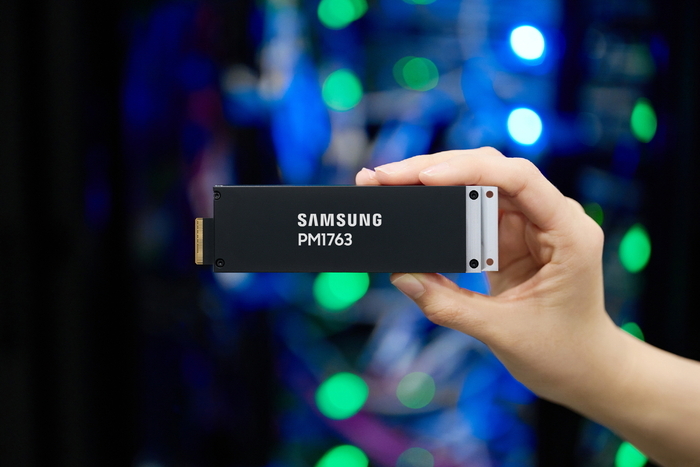
Samsung Electronics has begun mass production of its next-generation enterprise solid-state drive (eSSD), optimized specifically for artificial intelligence (AI) infrastructure. The rollout is set for integration into global AI accelerator platforms--most notably Nvidia's upcoming architectures--marking the start of Samsung's push to cement its competitive edge in high-capacity storage. The move mirrors the leadership strategy the company has pursued in High Bandwidth Memory (HBM).
Samsung announced on July 8 that it has kicked off high-volume manufacturing of the PM1763, a cutting-edge PCIe 6.0-based eSSD. The drive previously turned heads at Nvidia's GTC 2026 developer conference in March, where it was showcased alongside HBM4 and LPCAMM2 as a core component of Nvidia's next-generation “Vera Rubin” AI platform. With Nvidia scheduled to launch Vera Rubin later this year, Samsung has moved quickly to secure its position as a key storage supplier for the platform.
The PM1763 integrates Samsung's advanced 9th-generation V-NAND alongside a newly designed 4-nanometer (nm) controller, delivering major gains in both processing performance and thermal efficiency. Offered in capacities of 4TB, 8TB, and 16TB, the flagship 16TB variant boasts sequential read and write speeds of up to 28,400 MB/s and 21,900 MB/s, respectively--double the performance of its predecessor. At that speed, the drive can transfer a 40-gigabyte (GB) large language model (LLM) in just 1.4 seconds, significantly reducing data latency between accelerators and processors.
Engineered for the rigorous thermal demands of next-generation AI data centers, the PM1763 is fully optimized for liquid-cooling environments. It uses a Direct-to-Chip (D2C) cooling method, in which a cold plate attaches directly to the storage components. This design allows the drive to sustain peak performance during heavy, prolonged AI workloads without thermal throttling. It also boosts overall power efficiency by more than 1.8 times compared to previous models.
Security has been reinforced with Post-Quantum Cryptography (PQC) algorithms to guard against potential quantum-computing breaches, along with TDISP (TEE Device Interface Security Protocol) technology to secure data pathways in virtualized environments.
“The PM1763 successfully meets the stringent requirements of global customers' next-generation AI platforms, backed by industry-leading performance and rigorous product validation,” said Jangseok Choi, Vice President of the Memory Product Planning Team at Samsung Electronics. “This drive will serve as a foundational solution that allows our clients to scale memory capacity and operate their AI models with maximum efficiency.”
Samsung's mass-production launch is expected to intensify competition in the eSSD market, which has boomed alongside surging global AI infrastructure investment. As generative AI scales up, the volume of data required for training and inference has skyrocketed, making high-speed, reliable eSSDs critical for feeding data to AI accelerators.
According to market tracker TrendForce, Samsung Electronics led the global eSSD market in the first quarter with a 35.1% share, followed by SK Hynix at 23.1% and U.S.-based Micron at 15.4%. Rivals are moving fast to challenge Samsung's lead: SK Hynix is accelerating its supply chain timeline and plans to break ground on its new M17 fab in Cheongju next year, targeting operations in the first half of 2029, while Micron is closing the gap with its own ultra-high-capacity eSSD lineup.

