








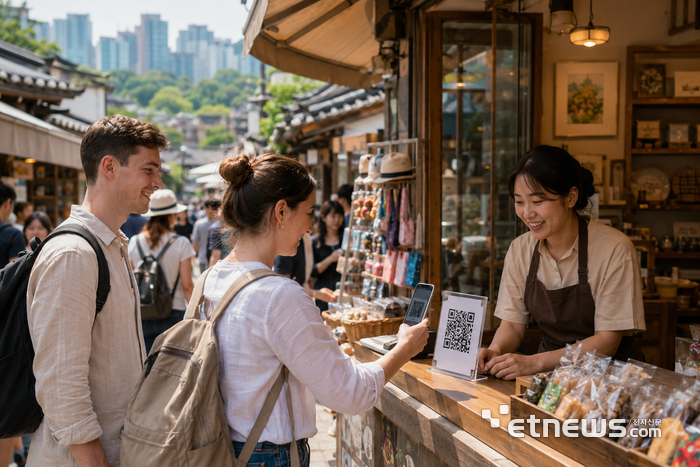
In step with the increasing number of foreign tourists, the government and the tourism industry are accelerating the expansion of “standard QR payments.” As recent travel trends to Korea shift from large tourist destinations to alley commercial districts, road shops, and individual experiential consumption, they are expanding infrastructure so that foreign tourists can pay with their domestic simple payment apps even in small-scale shops. Foreigners from 22 countries can pay directly with their home country's payment apps without currency exchange even in domestic alley commercial districts and small-scale shops.
According to the industry on the 26th, the Korea Tourism Organization (KTO) is promoting a standard QR distribution project to enhance the payment convenience of foreign visitors to Korea. The intention is to promote shopping tourism and expand domestic consumption by expanding payment accessibility.
Standard QR integrates multiple overseas simple payment services into a single QR code. It is linked with “Zero Pay,” operated by the Korea Easy Payment Foundation (KEPF). The Zero Pay-based standard QR is connected with 71 overseas payment services from 22 countries. Users of overseas simple payment apps, such as China's Alipay, WeChat Pay, UnionPay, and Taiwan's PX Pay, can pay directly without currency exchange.
A total of 44,000 sets of mobile payment standard QR kits will be distributed to regional tourism hubs like Busan, commercial districts near local airports and ports such as Cheongju, Daegu, and Yeosu, and major tourism areas.
The core of the project lies in the “distribution targets.” It is distributed focusing on small shops and alley commercial districts. Already, a significant number of large franchises, convenience stores, and large affiliated stores in major tourist destinations across the country have signed direct contracts with overseas payment companies or support overseas QR payments through separate payment terminals.
On the other hand, the standard QR expanded by the KTO is structured so that a QR kit is placed in small business shops and consumers scan it to pay. Even without separate expensive terminals, payments can be made with the standard QR kit of the organization. This means extending the overseas payment network to alley commercial districts and small shops where infrastructure construction was difficult.
In fact, recent tourism trends in visiting Korea are changing from focusing on large tourist destinations to individual tours, road shops, and alley experiences. As cases of foreign tourists directly visiting traditional markets, neighborhood cafes, street food restaurants, and regional experiential spaces increase, the demand for overseas simple payment is growing even in small-scale commercial districts.
The reason the KTO selected Busan as one of its core hubs is also because Busan is ranked as one of the cities with the highest influx of foreign tourists after Seoul. Previously, ahead of the Asia-Pacific Economic Cooperation (APEC) summit last year, the organization expanded foreign payment infrastructure by distributing about 70,000 mobile payment standard QRs mainly in the Gyeongsang region, including Gyeongju.
An official from the KTO said, “Foreign tourists are no longer staying only in Seoul but are visiting various parts of the regions,” and added, “The experience of paying directly with their home country's simple payment even in rural areas is expected to make them stay longer in Korea and increase consumption even more.”
