








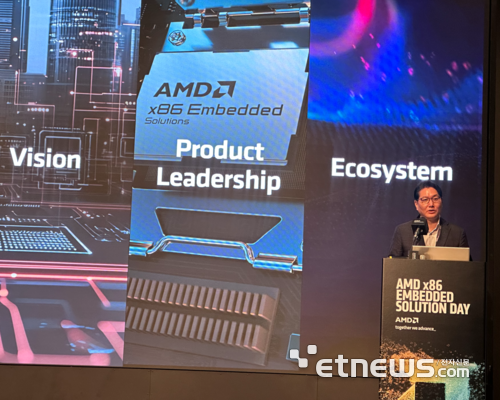
AMD is positioning embedded solutions as a key growth engine for its next phase of expansion. The chipmaker plans to leverage its proven x86 CPU strengths--already established in the data center and PC markets--and expand further into industrial computing.
At the 'AMD x86 Embedded Solution Day' held on June 10 at El Tower in Yangjae-dong, Seoul, Heeman Lee, Sales Representative of AMD AECG Korea, highlighted the company's expansion. “We are scaling our x86 success from data centers, PCs, and gaming into the embedded landscape,” Lee said. “Our global footprint now spans more than 7,000 embedded customers, including automotive, healthcare devices, broadcasting equipment and satellites.”
Embedded solutions refer to specialized computing systems integrated into sectors such as automotive, robotics, medical devices and telecommunications to perform dedicated tasks. Unlike general-purpose PCs or servers, these systems are designed to deliver the control, computing, visualization and AI capabilities required in specific industrial environments.
To strengthen its position, AMD expanded its AI embedded platform lineup this year. The newly introduced P100 and X100 series processors leverage the high-performance Zen 5 architecture. Built on x86 performance, these single-chip solutions integrate real-time visualization, advanced graphics and a low-latency, low-power neural processing unit (NPU), enabling industrial control, graphics and AI workloads on a unified platform.
According to Lee, AMD's strategy is built on two core platforms: EPYC for data center servers and Ryzen for PCs and gaming. “We deploy EPYC architectures where high-performance computing is critical, while leveraging Ryzen for sectors that require flexible, adaptive configurations, such as robotics and humanoids,” he said.
Lee also stressed that AMD's key differentiator is its long embedded computing heritage. Embedded devices operate in challenging environments--from industrial floors with vibration and heat to outdoor robotics and automotive systems--so they require rugged hardware and long-term software support.
“AMD's core strength lies in the embedded computing heritage it inherited through Xilinx, along with a robust portfolio of intellectual property that supports software functionality and security,” Lee added.
Looking ahead, AMD aims to connect its legacy ecosystem with its expanding embedded x86 business. “For more than two decades, we have cultivated a global network of over 400 partnerships in FPGA and adaptive SoC technologies,” Lee said. “We plan to extend that ecosystem into our embedded x86 business to better meet diverse customer demands.”
