








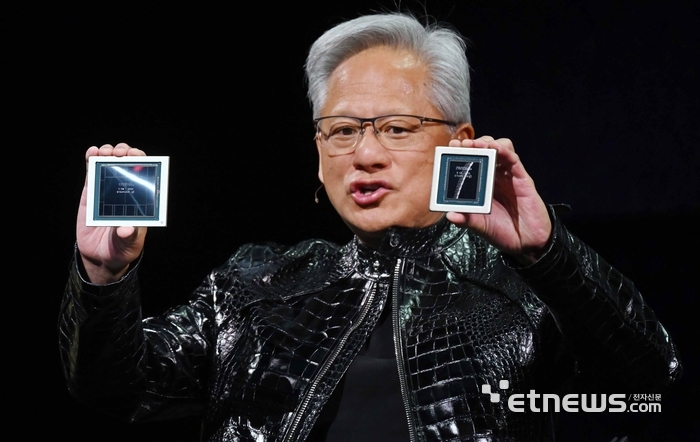
The government will invest a budget of 2 trillion won to secure 10,000 units of the latest high-performance graphics processing units (GPUs), including 'Vera Rubin', in order to vitalize the domestic artificial intelligence (AI) ecosystem.
The Ministry of Science and ICT (MSIT) announced on the 8th that it has selected NAVER Cloud, Samsung SDS, and Elice Group as the final participating companies for the 'Advanced GPU Acquisition, Construction, and Operation Support Project'.
This project was promoted as part of building the 'AI Highway', which is a core pillar of AI infrastructure. Following the first project last year, 2.08 trillion won will be invested this year.
The three cloud service providers (CSPs) selected this year will secure a total of 9,704 units, including 2,016 units of the next-generation high-performance GPU Vera Rubin and 7,688 units of 'B300', to construct them in data centers and launch services. The construction scale by provider is 1,008 Vera Rubin units and 3,112 B300 units for NAVER Cloud; 1,008 Vera Rubin units and 2,016 B300 units for Samsung SDS; and 2,560 B300 units for Elice Group.
MSIT previously invested 1.5 trillion won in the first project conducted last year to introduce 13,000 GPUs. It explained that this year, amid a situation where construction costs rose due to increased memory and storage prices, it improved project efficiency by introducing the latest high-performance models. The Vera Rubin, introduced for the first time through the government budget, features a significantly improved operation speed compared to existing models. It is anticipated that the time and cost required for AI model training will be greatly reduced because it can decrease data bottlenecks and process more requests within the same timeframe.

The computing performances announced by Nvidia are 35 petaflops (PF) for Vera Rubin, 13.5 PF for B300, and 9 PF for B200. 1 PF is a unit that can process 1 quadrillion mathematical operations per second, meaning 1 Vera Rubin unit can perform 35 quadrillion operations per second. Converting this based on the B200, it means that the government has secured a GPU resource scale of 19,000 units, which exceeds the original target of 15,000 units by 30%.
The government will dualize and operate the secured GPU resources according to demand. It will intensively deploy 2,016 Vera Rubin units and 4,360 B300 units to support the development of independent AI foundation models, national AI projects, and the advancement of AI services across industry, academia, and research institutes. The remaining 3,328 B300 units will be utilized directly by the selected CSPs, taking into account their own operating expenses and other factors. They are scheduled to be used for providing cloud-based GPU services and advancing their own AI models.
Through this project, private companies and research institutes are expected to boost their AI capabilities, while CSPs will accumulate infrastructure operation experience to secure global competitiveness. The three CSPs also decided to further explore ways to contribute to the AI ecosystem, such as providing AI services in the private sector and sharing cases of independent development.
A total of five companies submitted bids for the public tender, which was conducted for a month starting last March. Following document reviews, business capability evaluations, and on-site inspections, the final three companies were selected. The government and the three CSPs will begin placing purchase orders for the GPUs within June to commence construction. As soon as delivery and construction are completed, B300 services will be launched sequentially within the year, and Vera Rubin plans to showcase its service within the first half of 2027, taking into account the global release schedule.
Bae Kyung-hoon, deputy prime minister and minister of science and ICT, said, “The advanced GPUs to be secured this time, including Vera Rubin, will become a core driving force to accelerate domestic AI research and development and elevate technological capabilities,” and added, “We will secure world-class AI infrastructure capabilities to support the innovation and growth of domestic enterprises and research institutions.”
